Ch.1 - Structure and Bonding
Wade - Organic Chemistry 9th Edition
Wade9th EditionOrganic ChemistryISBN: 9780135213728Not the one you use?Change textbook
Chapter 1, Problem 6i-l

Draw Lewis structures for the following compounds and ions, showing appropriate ­formal charges.
(i) (CH3)2O—BF3
(j) [HONH3]+
(k) KOC(CH3)3
(l) [H2C=OH]+

Verified step by step guidance
1
Step 1: Begin by identifying the total number of valence electrons for each compound or ion. For (CH3)2O—BF3, calculate the valence electrons from carbon, hydrogen, oxygen, and boron. For [HONH3]+, consider the valence electrons from hydrogen, oxygen, and nitrogen, and account for the positive charge. For KOC(CH3)3, include potassium, oxygen, and carbon. For [H2C=OH]+, consider hydrogen, carbon, and oxygen, and account for the positive charge.
Step 2: Arrange the atoms in a skeletal structure. Typically, the least electronegative atom is central. For (CH3)2O—BF3, oxygen is central between the two CH3 groups, and boron is attached to oxygen. For [HONH3]+, nitrogen is central with hydrogen and oxygen attached. For KOC(CH3)3, carbon is central with oxygen and potassium attached. For [H2C=OH]+, carbon is central with hydrogen and oxygen attached.
Step 3: Distribute the valence electrons around the atoms to satisfy the octet rule (or duet for hydrogen). Start by placing electrons as bonds between atoms, then distribute remaining electrons as lone pairs. For (CH3)2O—BF3, ensure boron has only six electrons as it is an exception to the octet rule. For [HONH3]+, ensure nitrogen has a full octet. For KOC(CH3)3, ensure carbon has a full octet. For [H2C=OH]+, ensure carbon and oxygen have full octets.
Step 4: Assign formal charges to each atom. Formal charge is calculated using the formula: Formal Charge = (Valence Electrons) - (Non-bonding Electrons) - (Bonding Electrons/2). Calculate the formal charge for each atom in the structures to ensure the overall charge matches the given charge of the compound or ion.
Step 5: Verify the stability of the Lewis structures. Check that the formal charges are minimized and that the structure adheres to the rules of chemical bonding. Adjust the structure if necessary to achieve the most stable configuration, ensuring that the total charge of the molecule or ion is correct.

Verified video answer for a similar problem:

This video solution was recommended by our tutors as helpful for the problem above.
Video duration:
11m
Was this helpful?

Key Concepts

Here are the essential concepts you must grasp in order to answer the question correctly.

Lewis Structures

Lewis structures are diagrams that represent the bonding between atoms of a molecule and the lone pairs of electrons that may exist. They are essential for visualizing the arrangement of atoms, the distribution of electrons, and the formal charges in a molecule. Understanding how to draw Lewis structures involves knowing the valence electrons for each atom and applying the octet rule where applicable.
Recommended video:
Guided course
04:12
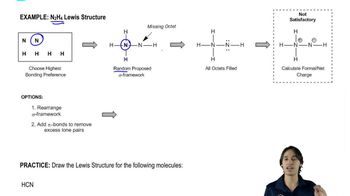
Drawing the Lewis Structure for N2H4.

Formal Charge

Formal charge is a theoretical charge assigned to an atom in a molecule, calculated by assuming equal sharing of electrons in bonds. It is determined using the formula: Formal Charge = (Valence Electrons) - (Non-bonding Electrons) - (Bonding Electrons/2). Calculating formal charges helps in identifying the most stable Lewis structure by minimizing the charges across the molecule.
Recommended video:
Guided course
01:34
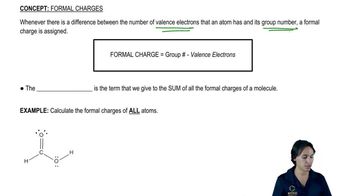
Calculating formal and net charge.

Resonance Structures

Resonance structures are different Lewis structures for the same molecule that depict the delocalization of electrons. They are used when a single Lewis structure cannot accurately represent the electron distribution. Resonance structures are important for understanding the stability and reactivity of molecules, as the true structure is a hybrid of all possible resonance forms.
Recommended video:
Guided course
03:04
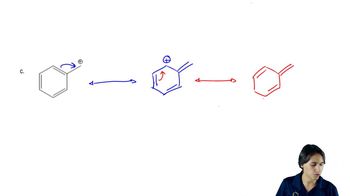
Drawing Resonance Structures