Ch.1 - Structure and Bonding
Wade - Organic Chemistry 9th Edition
Wade9th EditionOrganic ChemistryISBN: 9780135213728Not the one you use?Change textbook
Chapter 1, Problem 54f

Predict the hybridization and geometry of the carbon and nitrogen atoms in the following molecules and ions. (Hint: Resonance.)
f. Chemical structure showing a nitrogen atom bonded to an oxygen atom and a hydrogen atom, with resonance indicated.

Verified step by step guidance
1
Identify the structure of the molecule: The given structure is a five-membered ring with an oxygen atom, a nitrogen atom, and a positive charge on the oxygen. This is a pyrrole-like structure with an additional oxygen atom.
Determine the hybridization of the carbon atoms: In a five-membered ring with alternating double bonds, the carbon atoms are typically sp² hybridized. This allows for the formation of a planar structure with 120-degree bond angles.
Analyze the nitrogen atom: The nitrogen atom in this structure is bonded to two carbon atoms and one hydrogen atom, and it has a lone pair. In pyrrole, the nitrogen is sp² hybridized, allowing the lone pair to participate in resonance with the π system of the ring.
Consider the oxygen atom: The oxygen atom has a positive charge, indicating it is likely involved in resonance. Typically, oxygen in such structures is sp² hybridized, allowing for resonance stabilization of the positive charge.
Conclude the geometry: The sp² hybridization of the carbon and nitrogen atoms suggests a planar geometry for the ring, with bond angles close to 120 degrees. The resonance in the ring stabilizes the structure, allowing for delocalization of electrons.

Verified video answer for a similar problem:

This video solution was recommended by our tutors as helpful for the problem above.
Video duration:
6m
Was this helpful?

Key Concepts

Here are the essential concepts you must grasp in order to answer the question correctly.

Hybridization

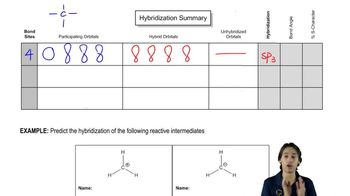
Hybridization is the process of mixing atomic orbitals to form new hybrid orbitals, which can explain the geometry and bonding properties of molecules. For carbon and nitrogen atoms, common hybridizations include sp3, sp2, and sp, corresponding to tetrahedral, trigonal planar, and linear geometries, respectively. Determining hybridization involves counting the number of sigma bonds and lone pairs around the atom.
Recommended video:
Guided course
10:43
Using bond sites to predict hybridization

Molecular Geometry

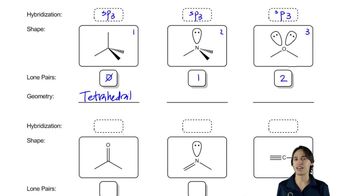
Molecular geometry refers to the three-dimensional arrangement of atoms within a molecule. It is influenced by the hybridization of the central atom and the presence of lone pairs. For example, sp3 hybridization typically results in a tetrahedral shape, while sp2 leads to a trigonal planar geometry. Understanding geometry is crucial for predicting molecular behavior and reactivity.
Recommended video:
Guided course
07:44
Molecular Geometry Explained.

Resonance

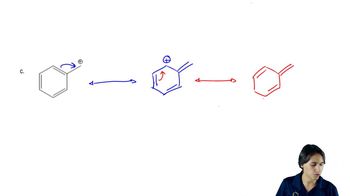
Resonance describes the delocalization of electrons across multiple structures, which stabilizes the molecule. It involves drawing resonance structures that depict different possible arrangements of electrons, particularly pi electrons and lone pairs. In the given molecule, resonance can affect the hybridization and geometry of the nitrogen atom, as it shares electrons with adjacent atoms, influencing its bonding and structure.
Recommended video:
Guided course
03:04
Drawing Resonance Structures