
Ch. 2 - Acids and Bases; Functional Groups
Wade - Organic Chemistry 9th Edition
Wade9th EditionOrganic ChemistryISBN: 9780135213728Not the one you use?Change textbook
Chapter 2, Problem 8

Calculate the pH of the following solutions.
a. 5.00 g of HBr in 100 mL of aqueous solution
b. 1.50 g of NaOH in 50 mL of aqueous solution

Verified step by step guidance
1
Step 1: Begin by calculating the molarity of the HBr solution. First, determine the number of moles of HBr using its molar mass. The molar mass of HBr is approximately 80.91 g/mol. Use the formula: \( \text{moles of HBr} = \frac{\text{mass of HBr}}{\text{molar mass of HBr}} \).
Step 2: Convert the volume of the solution from milliliters to liters. Since the volume is given as 100 mL, convert it to liters by dividing by 1000: \( \text{volume in liters} = \frac{100}{1000} \).
Step 3: Calculate the molarity of the HBr solution using the formula: \( \text{molarity} = \frac{\text{moles of HBr}}{\text{volume in liters}} \). Since HBr is a strong acid, it dissociates completely in water, and the concentration of \( \text{H}^+ \) ions will be equal to the molarity of the HBr solution.
Step 4: Calculate the pH of the HBr solution using the formula: \( \text{pH} = -\log[\text{H}^+] \), where \([\text{H}^+]\) is the molarity of the HBr solution.
Step 5: For the NaOH solution, repeat a similar process. Calculate the moles of NaOH using its molar mass (approximately 40.00 g/mol). Convert the volume from mL to liters (50 mL to 0.050 L). Calculate the molarity of NaOH, and since NaOH is a strong base, it dissociates completely, providing \([\text{OH}^-]\) equal to the molarity. Use the formula \( \text{pOH} = -\log[\text{OH}^-] \) and then find the pH using \( \text{pH} = 14 - \text{pOH} \).

Verified video answer for a similar problem:

This video solution was recommended by our tutors as helpful for the problem above.
Video duration:
7m
Was this helpful?

Key Concepts

Here are the essential concepts you must grasp in order to answer the question correctly.

Molarity

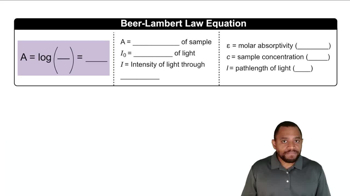
Molarity is a measure of the concentration of a solute in a solution, expressed as moles of solute per liter of solution (mol/L). To calculate molarity, you need to know the amount of solute in moles and the volume of the solution in liters. This concept is crucial for determining the concentration of HBr and NaOH in the given solutions.
Recommended video:
1:39
The Beer-Lambert Law Concept 2

pH Calculation

pH is a measure of the acidity or basicity of a solution, calculated as the negative logarithm of the hydrogen ion concentration (-log[H+]). For strong acids like HBr, which dissociate completely, the concentration of H+ ions is equal to the molarity of the acid. For strong bases like NaOH, the concentration of OH- ions can be used to find pH by first calculating pOH and then using the relation pH + pOH = 14.
Recommended video:
Guided course
04:37
Draw all of the monochlorination products and calculate percentage yields.

Strong Acid and Base Dissociation

Strong acids and bases dissociate completely in aqueous solutions, meaning they fully ionize into their constituent ions. HBr, a strong acid, dissociates into H+ and Br- ions, while NaOH, a strong base, dissociates into Na+ and OH- ions. Understanding this complete dissociation is essential for accurately calculating the concentration of ions in the solution, which directly affects the pH.
Recommended video:
Guided course
03:10
Monosaccharides - Strong Oxidation (Aldaric Acid)