
Ch. 2 - Acids and Bases; Functional Groups
Wade - Organic Chemistry 9th Edition
Wade9th EditionOrganic ChemistryISBN: 9780135213728Not the one you use?Change textbook
Chapter 2, Problem 29a,b,c

For each of the following compounds,
1. draw the Lewis structure.
2. show how the bond dipole moments (and those of any nonbonding pairs of electrons) contribute to the molecular dipole moment.
3. estimate whether the compound will have a large, small, or zero dipole moment.
a. CH3CH=NCH3
b. CH3CH2OH
c. CBr4

Verified step by step guidance
1
Step 1: For each compound, start by drawing the Lewis structure. Identify the central atom and arrange the surrounding atoms accordingly. Ensure that all atoms satisfy the octet rule, except for hydrogen, which follows the duet rule.
Step 2: For CH3CH=NCH3, draw the Lewis structure with a double bond between the carbon and nitrogen. For CH3CH2OH, draw the Lewis structure with an oxygen atom bonded to the second carbon and a hydrogen atom bonded to the oxygen. For CBr4, draw the Lewis structure with carbon as the central atom and four bromine atoms surrounding it.
Step 3: Identify the bond dipole moments. For CH3CH=NCH3, the C=N bond will have a dipole moment due to the difference in electronegativity between carbon and nitrogen. For CH3CH2OH, the C-O and O-H bonds will have dipole moments. For CBr4, the C-Br bonds will have dipole moments, but they will cancel out due to symmetry.
Step 4: Analyze how these bond dipole moments contribute to the overall molecular dipole moment. For CH3CH=NCH3, the dipole moments may not cancel out, leading to a net dipole moment. For CH3CH2OH, the dipole moments will add up, resulting in a significant molecular dipole moment. For CBr4, the symmetry of the molecule leads to a cancellation of dipole moments, resulting in a zero molecular dipole moment.
Step 5: Estimate the magnitude of the dipole moment for each compound. CH3CH=NCH3 is likely to have a small dipole moment due to partial cancellation of dipoles. CH3CH2OH will have a large dipole moment due to the strong dipole of the O-H bond. CBr4 will have a zero dipole moment due to its symmetrical tetrahedral shape.

Verified video answer for a similar problem:

This video solution was recommended by our tutors as helpful for the problem above.
Video duration:
4m
Was this helpful?

Key Concepts

Here are the essential concepts you must grasp in order to answer the question correctly.

Lewis Structures

Lewis structures are diagrams that represent the bonding between atoms of a molecule and the lone pairs of electrons that may exist. They are essential for visualizing the arrangement of atoms and electrons, helping to predict the geometry and reactivity of the molecule. Understanding how to draw Lewis structures is crucial for analyzing molecular properties such as dipole moments.
Recommended video:
Guided course
04:12
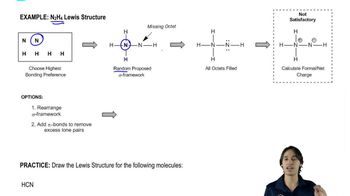
Drawing the Lewis Structure for N2H4.

Bond Dipole Moments

Bond dipole moments arise from differences in electronegativity between bonded atoms, creating a partial positive and negative charge across the bond. These dipoles can be represented as vectors pointing from the less electronegative atom to the more electronegative atom. Understanding bond dipole moments is key to determining the overall molecular dipole moment, which affects the molecule's polarity and interactions.
Recommended video:
Guided course
01:46
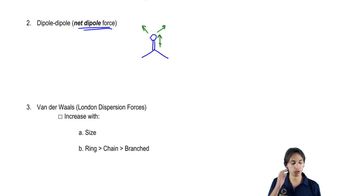
How dipole-dipole forces work.

Molecular Dipole Moment

The molecular dipole moment is the vector sum of all individual bond dipole moments and any lone pair contributions within a molecule. It indicates the overall polarity of the molecule, influencing properties like solubility and boiling point. Estimating the molecular dipole moment involves assessing the symmetry and arrangement of dipoles, which can result in a large, small, or zero dipole moment.
Recommended video:
Guided course
01:46
How dipole-dipole forces work.