
Ch. 2 - Acids and Bases; Functional Groups
Wade - Organic Chemistry 9th Edition
Wade9th EditionOrganic ChemistryISBN: 9780135213728Not the one you use?Change textbook
Chapter 2, Problem 30

Sulfur dioxide has a dipole moment of 1.60 D. Carbon dioxide has a dipole moment of zero, even though C―O bonds are more polar than S―O bonds. Explain this apparent contradiction.

Verified step by step guidance
1
Understand the concept of dipole moment: A dipole moment is a measure of the separation of positive and negative charges in a molecule. It is a vector quantity, meaning it has both magnitude and direction.
Analyze the molecular geometry of sulfur dioxide (SO₂): SO₂ has a bent shape due to the presence of a lone pair on the sulfur atom. This geometry causes the dipole moments of the S―O bonds to not cancel each other out, resulting in a net dipole moment.
Examine the molecular geometry of carbon dioxide (CO₂): CO₂ has a linear shape, with the carbon atom in the center and oxygen atoms on either side. The dipole moments of the C―O bonds are equal in magnitude but opposite in direction, leading to their cancellation and a net dipole moment of zero.
Consider the polarity of individual bonds: Although C―O bonds are more polar than S―O bonds, the overall molecular geometry plays a crucial role in determining the net dipole moment. In CO₂, the linear geometry results in no net dipole moment, while in SO₂, the bent geometry results in a net dipole moment.
Conclude the explanation: The apparent contradiction arises because the dipole moment of a molecule is not solely determined by the polarity of individual bonds but also by the molecular geometry, which affects how these bond dipoles interact and either cancel out or reinforce each other.

Verified video answer for a similar problem:

This video solution was recommended by our tutors as helpful for the problem above.
Video duration:
6m
Was this helpful?

Key Concepts

Here are the essential concepts you must grasp in order to answer the question correctly.

Dipole Moment

The dipole moment is a measure of the separation of positive and negative charges in a molecule, indicating its polarity. It is represented in Debye units (D) and arises from differences in electronegativity between bonded atoms. A non-zero dipole moment suggests an uneven distribution of charge, while a zero dipole moment indicates a symmetrical charge distribution.
Recommended video:
Guided course
01:46
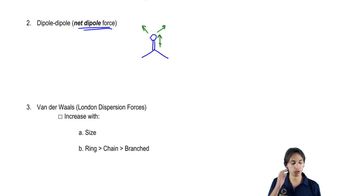
How dipole-dipole forces work.

Molecular Geometry

Molecular geometry refers to the three-dimensional arrangement of atoms within a molecule, which significantly influences its dipole moment. In sulfur dioxide (SO2), the bent shape leads to an uneven charge distribution, resulting in a dipole moment. Conversely, carbon dioxide (CO2) has a linear geometry, causing the dipoles from the C-O bonds to cancel each other out, resulting in a net dipole moment of zero.
Recommended video:
Guided course
07:44
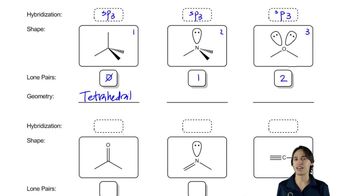
Molecular Geometry Explained.

Electronegativity

Electronegativity is the tendency of an atom to attract electrons in a chemical bond. Oxygen is more electronegative than both sulfur and carbon, making C-O and S-O bonds polar. However, the overall molecular polarity depends on the geometry; despite the higher polarity of C-O bonds, CO2's linear shape leads to a zero dipole moment, unlike SO2's bent shape, which results in a net dipole moment.
Recommended video:
Guided course
1:47
Electronegativity
Related Practice
Textbook Question

For each of the following compounds,

1. draw the Lewis structure.

2. show how the bond dipole moments (and those of any nonbonding pairs of electrons) contribute to the molecular dipole moment.

3. estimate whether the compound will have a large, small, or zero dipole moment.

e.

659
views
Textbook Question

Which of the following pure compounds can form hydrogen bonds? Which can form hydrogen bonds with water? Which ones do you expect to be soluble in water?

a. (CH3CH2)2NH

b. (CH3CH2)3N

c. CH3CH2CH2OH

d. (CH3CH2CH2)2OH

909
views
Textbook Question

Which of the following pure compounds can form hydrogen bonds? Which can form hydrogen bonds with water? Which ones do you expect to be soluble in water?

e. CH3(CH2)3CH3

f. CH2=CH—CH2CH3

g. CH3COCH3

h. CH3CH2COOH

2805
views
Textbook Question

For each of the following compounds,

1. draw the Lewis structure.

2. show how the bond dipole moments (and those of any nonbonding pairs of electrons) contribute to the molecular dipole moment.

3. estimate whether the compound will have a large, small, or zero dipole moment.

d.

995
views
Textbook Question

For each of the following compounds,

1. draw the Lewis structure.

2. show how the bond dipole moments (and those of any nonbonding pairs of electrons) contribute to the molecular dipole moment.

3. estimate whether the compound will have a large, small, or zero dipole moment.

a. CH3CH=NCH3

b. CH3CH2OH

c. CBr4

2466
views
Textbook Question

Predict which member of each pair is more soluble in water. Explain your prediction.

(a)

(b)

1471
views