
Ch. 2 - Acids and Bases; Functional Groups
Wade - Organic Chemistry 9th Edition
Wade9th EditionOrganic ChemistryISBN: 9780135213728Not the one you use?Change textbook
Chapter 2, Problem 51c

In each reaction, label the reactants as Lewis acids (electrophiles) or Lewis bases (nucleophiles). Use curved arrows to show the movement of electron pairs in the reactions. Draw any nonbonding electrons to show how they participate in the reactions.
c. Chemical reaction showing reactants and products with curved arrows indicating electron pair movement and labeled species.

Verified step by step guidance
1
Identify the reactants: In the given reaction, the reactants are acetaldehyde (CH₃CHO) and hydrochloric acid (HCl).
Determine the Lewis acid and Lewis base: Acetaldehyde has a carbonyl group (C=O) where the oxygen atom has lone pairs of electrons, making it a Lewis base (nucleophile). HCl can donate a proton (H⁺), making it a Lewis acid (electrophile).
Draw the curved arrows: The lone pair of electrons on the oxygen atom of acetaldehyde will attack the hydrogen atom of HCl, forming a bond between oxygen and hydrogen. This is shown with a curved arrow from the lone pair on oxygen to the hydrogen atom.
Show the movement of electrons: As the bond between H and Cl breaks, the electrons from the H-Cl bond move to the chlorine atom, forming Cl⁻. This is represented by a curved arrow from the H-Cl bond to the chlorine atom.
Draw nonbonding electrons: After the reaction, the oxygen atom in the product has a positive charge due to the formation of the O-H bond, and the chlorine atom has a negative charge due to the gain of electrons, forming Cl⁻. Ensure to show these charges and any nonbonding electrons involved in the process.

Verified video answer for a similar problem:

This video solution was recommended by our tutors as helpful for the problem above.
Video duration:
2m
Was this helpful?

Key Concepts

Here are the essential concepts you must grasp in order to answer the question correctly.

Lewis Acids and Bases

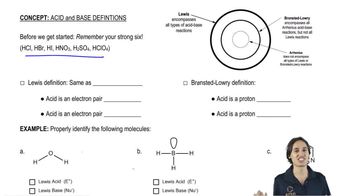
Lewis acids are species that accept electron pairs, while Lewis bases donate electron pairs. In the given reaction, HCl acts as a Lewis acid because it accepts an electron pair from the oxygen atom of the aldehyde, which acts as a Lewis base. Understanding these roles is crucial for identifying the movement of electrons in the reaction.
Recommended video:
Guided course
02:49
The Lewis definition of acids and bases.

Curved Arrow Notation

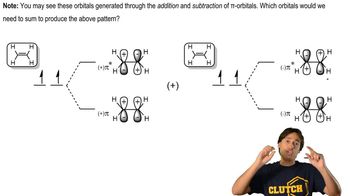
Curved arrows are used in organic chemistry to depict the movement of electron pairs during chemical reactions. In this reaction, a curved arrow would show the electron pair from the oxygen atom moving towards the hydrogen atom of HCl, indicating the formation of a new bond. This notation helps visualize the electron flow and the transformation of reactants to products.
Recommended video:
Guided course
06:20
Alternative MO Notation for Dienes

Nonbonding Electrons

Nonbonding electrons, or lone pairs, are valence electrons not involved in bonding. In the reaction, the lone pair on the oxygen atom of the aldehyde is crucial as it participates in forming a bond with the hydrogen from HCl. Recognizing the role of nonbonding electrons is essential for understanding how they influence reactivity and the mechanism of the reaction.
Recommended video:
Guided course
03:54
The 18 and 16 Electron Rule