Ch. 2 - Acids and Bases; Functional Groups
Wade - Organic Chemistry 9th Edition
Wade9th EditionOrganic ChemistryISBN: 9780135213728Not the one you use?Change textbook
Chapter 2, Problem 52c,d

Each of these compounds can react as an electrophile. In each case, use curved arrows to show how the electrophile would react with the strong nucleophile sodium ethoxide, Na+ OCH2CH3.
(c) CH3CH2Br
(d) BH3

Verified step by step guidance
1
Identify the electrophile in each compound. For CH3CH2Br, the electrophile is the carbon atom bonded to the bromine, as bromine is a good leaving group. For BH3, the boron atom is the electrophile due to its electron deficiency.
Consider the nucleophile, sodium ethoxide (Na+ −OCH2CH3). The ethoxide ion (−OCH2CH3) is the nucleophilic part, with the oxygen atom having a lone pair of electrons that can be donated.
For CH3CH2Br, draw a curved arrow from the lone pair on the oxygen of the ethoxide ion to the electrophilic carbon atom in CH3CH2Br. This represents the nucleophilic attack.
In the reaction with CH3CH2Br, also draw a curved arrow from the bond between the carbon and bromine to the bromine atom, indicating that the bromine will leave as a bromide ion (Br−).
For BH3, draw a curved arrow from the lone pair on the oxygen of the ethoxide ion to the boron atom. This represents the formation of a coordinate covalent bond between the nucleophile and the electrophile, as boron accepts the electron pair.

Verified video answer for a similar problem:

This video solution was recommended by our tutors as helpful for the problem above.
Video duration:
5m
Was this helpful?

Key Concepts

Here are the essential concepts you must grasp in order to answer the question correctly.

Electrophile

An electrophile is a chemical species that accepts an electron pair from a nucleophile to form a chemical bond. Electrophiles are typically positively charged or neutral species with an electron-deficient atom. In the context of the question, CH3CH2Br and BH3 act as electrophiles, seeking electrons from the nucleophile sodium ethoxide.
Recommended video:
Guided course
03:
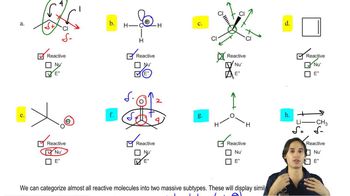
Nucleophile or Electrophile

Nucleophile

A nucleophile is a chemical species that donates an electron pair to an electrophile to form a chemical bond. Nucleophiles are typically negatively charged or neutral species with a lone pair of electrons. Sodium ethoxide (Na+ −OCH2CH3) acts as a strong nucleophile, with the ethoxide ion (−OCH2CH3) donating electrons to the electrophiles in the reaction.
Recommended video:
Guided course
08:27
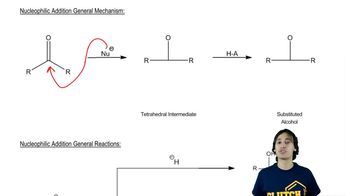
Nucleophilic Addition

Curved Arrow Notation

Curved arrow notation is used in organic chemistry to depict the movement of electron pairs during chemical reactions. The tail of the arrow starts at the electron pair donor (nucleophile) and points towards the electron pair acceptor (electrophile). In the given reactions, curved arrows will show the flow of electrons from the nucleophile sodium ethoxide to the electrophiles CH3CH2Br and BH3, illustrating the formation of new bonds.
Recommended video:
Guided course
06:20
Alternative MO Notation for Dienes