
Ch. 2 - Acids and Bases; Functional Groups
Wade - Organic Chemistry 9th Edition
Wade9th EditionOrganic ChemistryISBN: 9780135213728Not the one you use?Change textbook
Chapter 2, Problem 39c

The Ka of phenylacetic acid is 5.2 × 10⁻⁵, and the pKa of propionic acid is 4.87.

c. Predict whether the following equilibrium will favor the reactants or the products.

Verified step by step guidance
1
Identify the acids and their conjugate bases in the equilibrium. Phenylacetic acid (C₆H₅CH₂COOH) and propionic acid (CH₃CH₂COOH) are the acids, while their conjugate bases are C₆H₅CH₂COO⁻ and CH₃CH₂COO⁻ respectively.
Determine the strength of the acids using their Ka and pKa values. Phenylacetic acid has a Ka of 5.2 × 10⁻⁵, and propionic acid has a pKa of 4.87. Convert the pKa of propionic acid to Ka using the formula: Ka = 10^(-pKa).
Compare the Ka values to determine which acid is stronger. The acid with the higher Ka value is stronger, meaning it dissociates more in solution.
Predict the direction of the equilibrium based on acid strength. The equilibrium will favor the formation of the weaker acid and its conjugate base, as the stronger acid will donate its proton more readily.
Conclude whether the equilibrium favors the reactants or products. If phenylacetic acid is stronger, the equilibrium will favor the products. If propionic acid is stronger, the equilibrium will favor the reactants.

Verified video answer for a similar problem:

This video solution was recommended by our tutors as helpful for the problem above.
Video duration:
2m
Was this helpful?

Key Concepts

Here are the essential concepts you must grasp in order to answer the question correctly.

Acid Dissociation Constant (Ka)

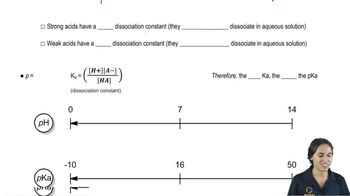
The acid dissociation constant (Ka) quantifies the strength of an acid in solution. It is defined as the equilibrium constant for the dissociation of an acid into its conjugate base and a proton. A higher Ka value indicates a stronger acid, as it dissociates more completely in solution. In this case, phenylacetic acid has a Ka of 5.2 × 10⁻⁵, indicating it is a weak acid.
Recommended video:
Guided course
02:19
The relationship between equilibrium constant and pKa.

pKa and Its Significance

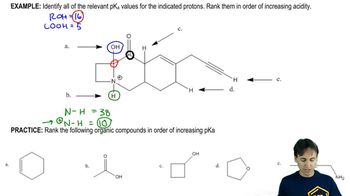
The pKa is the negative logarithm of the Ka value and provides a more convenient way to express acid strength. Lower pKa values correspond to stronger acids. For propionic acid, the pKa is 4.87, which is lower than that of phenylacetic acid, suggesting that propionic acid is a stronger acid. Understanding pKa is essential for predicting the direction of acid-base equilibria.
Recommended video:
Guided course
07:45
Identifying pKa values

Equilibrium and Le Chatelier's Principle

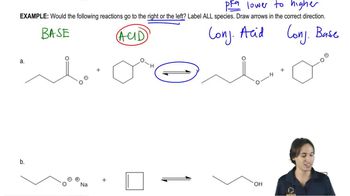
Chemical equilibrium occurs when the rates of the forward and reverse reactions are equal, resulting in constant concentrations of reactants and products. Le Chatelier's Principle states that if a system at equilibrium is disturbed, it will shift in a direction that counteracts the disturbance. In this context, comparing the strengths of the acids will help predict whether the equilibrium favors the reactants or products in the given reaction.
Recommended video:
Guided course
04:00
Determining Acid/Base Equilibrium
Related Practice