
Textbook Question
Each of these compounds can react as a nucleophile. In each case, use curved arrows to show how the nucleophile would react with the strong electrophile BF3.
(e) CH3CH2OH
552
views

 Verified step by step guidance
 07:45
07:45
 03:27
03:27 03:43
03:43Each of these compounds can react as a nucleophile. In each case, use curved arrows to show how the nucleophile would react with the strong electrophile BF3.
(e) CH3CH2OH
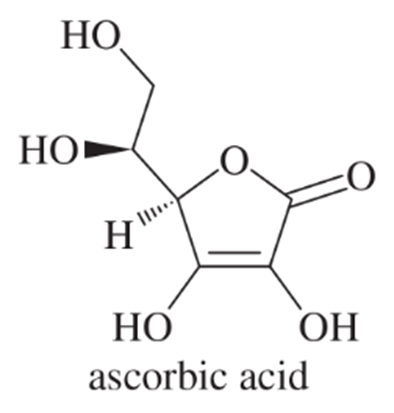
The pKa of ascorbic acid (vitamin C, page 55) is 4.17, showing that it is slightly more acidic than acetic acid (CH3COOH, pKa 4.74).
a. Show the four different conjugate bases that would be formed by deprotonation of the four different OH groups in ascorbic acid.
b. Compare the stabilities of these four conjugate bases, and predict which OH group of ascorbic acid is the most acidic.
Each of these compounds can react as a nucleophile. In each case, use curved arrows to show how the nucleophile would react with the strong electrophile BF3.
(f) (CH3)2S
Many naturally occurring compounds contain more than one functional group. Identify the functional groups in the following compounds:
a. Penicillin G is a naturally occurring antibiotic.
b. Dopamine is the neurotransmitter that is deficient in Parkinson’s disease.
Many naturally occurring compounds contain more than one functional group. Identify the functional groups in the following compounds:
d. Thyroxine is the principal thyroid hormone.