Ch. 2 - Acids and Bases; Functional Groups
Wade - Organic Chemistry 9th Edition
Wade9th EditionOrganic ChemistryISBN: 9780135213728Not the one you use?Change textbook
Chapter 2, Problem 53f

Each of these compounds can react as a nucleophile. In each case, use curved arrows to show how the nucleophile would react with the strong electrophile BF3.
(f) (CH3)2S

Verified step by step guidance
1
Identify the nucleophile and electrophile in the reaction. In this case, the nucleophile is dimethyl sulfide ((CH3)2S) and the electrophile is boron trifluoride (BF3).
Understand the nature of the nucleophile and electrophile. Dimethyl sulfide ((CH3)2S) has a lone pair of electrons on the sulfur atom, making it a good nucleophile. Boron trifluoride (BF3) is an electron-deficient molecule, making it a strong electrophile.
Use curved arrows to represent the movement of electrons. Draw a curved arrow from the lone pair on the sulfur atom of (CH3)2S to the boron atom in BF3. This indicates the formation of a coordinate covalent bond between sulfur and boron.
Consider the geometry and hybridization changes. The boron atom in BF3 is sp2 hybridized and trigonal planar. Upon accepting the lone pair from sulfur, it becomes sp3 hybridized and adopts a tetrahedral geometry.
Verify the stability of the resulting adduct. The formation of the S-B bond results in a stable adduct due to the complete octet around boron, and the positive charge on sulfur is stabilized by the electron-donating methyl groups.

Verified video answer for a similar problem:

This video solution was recommended by our tutors as helpful for the problem above.
Video duration:
3m
Was this helpful?

Key Concepts

Here are the essential concepts you must grasp in order to answer the question correctly.

Nucleophiles

Nucleophiles are species that donate an electron pair to form a chemical bond in reaction mechanisms. They are typically rich in electrons and can be negatively charged ions or neutral molecules with lone pairs. Understanding nucleophiles is crucial for predicting how they will interact with electrophiles in organic reactions.
Recommended video:
Guided course
08:27
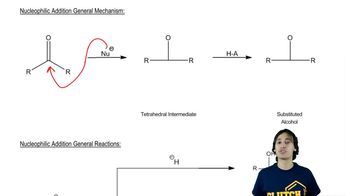
Nucleophilic Addition

Electrophiles

Electrophiles are species that accept an electron pair, often characterized by a positive charge or an electron-deficient atom. In the context of the question, BF3 acts as a strong electrophile due to its electron-deficient boron atom, which makes it highly reactive towards nucleophiles like (CH3)2S.
Recommended video:
Guided course
03:
Nucleophile or Electrophile

Curved Arrow Notation

Curved arrow notation is a fundamental tool in organic chemistry used to depict the movement of electrons during chemical reactions. It helps visualize how nucleophiles donate electron pairs to electrophiles, indicating the formation or breaking of bonds. Mastery of this notation is essential for accurately representing reaction mechanisms.
Recommended video:
Guided course
06:20
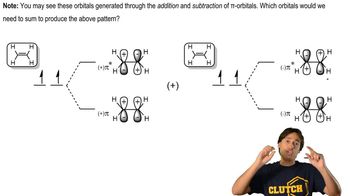
Alternative MO Notation for Dienes
Related Practice
Textbook Question

Each of these compounds can react as a nucleophile. In each case, use curved arrows to show how the nucleophile would react with the strong electrophile BF3.

(e) CH3CH2OH

552
views

Textbook Question

The pKa of ascorbic acid (vitamin C, page 55) is 4.17, showing that it is slightly more acidic than acetic acid (CH3COOH, pKa 4.74).

a. Show the four different conjugate bases that would be formed by deprotonation of the four different OH groups in ascorbic acid.

b. Compare the stabilities of these four conjugate bases, and predict which OH group of ascorbic acid is the most acidic.

1076
views
Textbook Question

The pKa of ascorbic acid (vitamin C, page 55) is 4.17, showing that it is slightly more acidic than acetic acid (CH3COOH, pKa 4.74).

c. Compare the most stable conjugate base of ascorbic acid with the conjugate base of acetic acid, and suggest why these two compounds have similar acidities, even though ascorbic acid lacks the carboxylic acid (COOH) group.

5238
views
1
rank
1
comments
Textbook Question

Each of these compounds can react as an electrophile. In each case, use curved arrows to show how the electrophile would react with the strong nucleophile sodium ethoxide, Na+ OCH2CH3.

(c) CH3CH2Br

(d) BH3

1470
views
Textbook Question

Many naturally occurring compounds contain more than one functional group. Identify the functional groups in the ­following compounds:

a. Penicillin G is a naturally occurring antibiotic.

b. Dopamine is the neurotransmitter that is deficient in Parkinson’s disease.

1003
views
Textbook Question

Each of these compounds can react as a nucleophile. In each case, use curved arrows to show how the nucleophile would react with the strong electrophile BF3.

(a)

(b)

1209
views