
Ch.10 - Structure and Synthesis of Alcohols
Wade - Organic Chemistry 9th Edition
Wade9th EditionOrganic ChemistryISBN: 9780135213728Not the one you use?Change textbook
Chapter 10, Problem 7d

Predict which member of each pair will be more acidic. Explain your answers.
d. 2,2-dichloropropan-1-ol or 2,2-difluoropropan-1-ol

Verified step by step guidance
1
Step 1: Recall the concept of acidity in organic compounds. Acidity is influenced by the stability of the conjugate base formed after the compound donates a proton (H⁺). The more stable the conjugate base, the more acidic the compound.
Step 2: Analyze the structures of the two compounds. Both compounds are alcohols (propan-1-ol derivatives) with halogen substituents at the 2,2-position. The halogens (chlorine and fluorine) are electronegative and can stabilize the conjugate base through inductive effects.
Step 3: Compare the electronegativity of chlorine and fluorine. Fluorine is more electronegative than chlorine, meaning it exerts a stronger inductive effect. This stronger inductive effect stabilizes the conjugate base of 2,2-difluoropropan-1-ol more effectively than the conjugate base of 2,2-dichloropropan-1-ol.
Step 4: Consider the impact of the inductive effect on acidity. The stronger inductive effect of fluorine in 2,2-difluoropropan-1-ol increases the acidity of the compound compared to 2,2-dichloropropan-1-ol.
Step 5: Conclude that 2,2-difluoropropan-1-ol is more acidic than 2,2-dichloropropan-1-ol due to the greater electronegativity of fluorine, which stabilizes the conjugate base more effectively through a stronger inductive effect.

Verified video answer for a similar problem:

This video solution was recommended by our tutors as helpful for the problem above.
Video duration:
6m
Was this helpful?

Key Concepts

Here are the essential concepts you must grasp in order to answer the question correctly.

Acidity and pKa

Acidity in organic chemistry refers to the tendency of a compound to donate a proton (H+). The strength of an acid is often measured by its pKa value; lower pKa values indicate stronger acids. Understanding the relationship between molecular structure and acidity is crucial for predicting which compound will be more acidic in a given comparison.
Recommended video:
Guided course
07:45
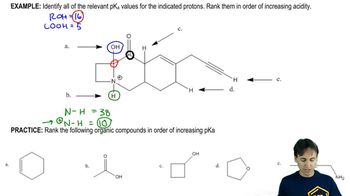
Identifying pKa values

Inductive Effect

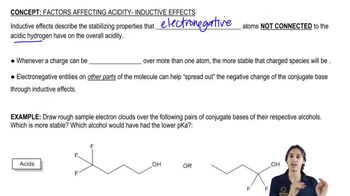
The inductive effect describes how the presence of electronegative atoms or groups in a molecule can influence the acidity of a nearby acidic proton. Electronegative atoms, such as chlorine and fluorine, can stabilize the negative charge on the conjugate base formed after deprotonation, thereby increasing acidity. The strength of this effect varies with the electronegativity and distance of the substituents from the acidic site.
Recommended video:
Guided course
01:47
Understanding the Inductive Effect.

Comparative Analysis of Substituents

When comparing the acidity of two compounds, it is essential to analyze the substituents attached to the carbon bearing the hydroxyl group. In this case, 2,2-dichloropropan-1-ol and 2,2-difluoropropan-1-ol have different halogen substituents, which will affect their acidity. The more electronegative fluorine is expected to exert a stronger inductive effect than chlorine, leading to a greater stabilization of the conjugate base and thus a higher acidity for the difluorinated compound.
Recommended video:
Guided course
02:41
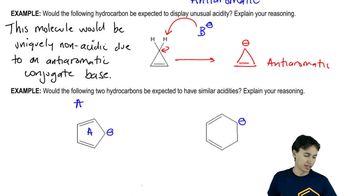
Comparing hydrocarbon acidity
Related Practice
Textbook Question

A nitro group (–NO2) effectively stabilizes a negative charge on an adjacent carbon atom through resonance:

Two of the following nitrophenols are much more acidic than phenol itself. The third compound is only slightly more acidic than phenol. Use resonance structures of the appropriate phenoxide ions to show why two of these anions should be unusually stable.

3684
views
Textbook Question

Dimethylamine, (CH3)2NH, has a molecular weight of 45 and a boiling point of 7.4 °C. Trimethylamine, (CH3)3N, has a higher molecular weight (59) but a lower boiling point (3.5 °C). Explain this apparent discrepancy.

1425
views
Textbook Question

Without looking them up, rank the following compounds in decreasing order of acidity. These examples represent large classes of compounds that differ widely in acidity.

water, ethanol, 2-chloroethanol, tert-butyl alcohol, ammonia, sulfuric acid, hexane, hex-1-yne, acetic acid

875
views
Textbook Question
For each molecular formula, draw all the possible constitutional isomers of alcohols with that formula. Give the IUPAC name for each alcohol.(a) C3H8O(b) C4H10O(c) C3H6O(d) C3H4O
1190
views
Textbook Question

Predict which member of each pair will be more soluble in water. Explain the reasons for your answers.

(a) hexan-1-ol or cyclohexanol

(b) heptan-1-ol or 4-methylphenol

(c) 3-ethylhexan-3-ol or octan-2-ol

(d) hexan-2-ol or cyclooctane-1,4-diol

(e)


1340
views
Textbook Question

Predict which member of each pair will be more acidic. Explain your answers.

c. 2-chloroethanol or 2,2-dichloroethanol

1159
views