Ch.10 - Structure and Synthesis of Alcohols
Wade - Organic Chemistry 9th Edition
Wade9th EditionOrganic ChemistryISBN: 9780135213728Not the one you use?Change textbook
Chapter 10, Problem 5

Predict which member of each pair will be more soluble in water. Explain the reasons for your answers.
(a) hexan-1-ol or cyclohexanol
(b) heptan-1-ol or 4-methylphenol
(c) 3-ethylhexan-3-ol or octan-2-ol
(d) hexan-2-ol or cyclooctane-1,4-diol
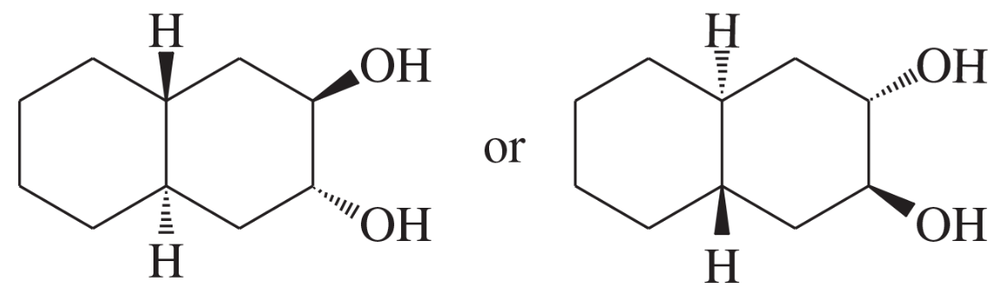
(e)

Verified step by step guidance
1
Step 1: Solubility in water is influenced by the ability of a molecule to form hydrogen bonds with water. Molecules with polar functional groups, such as hydroxyl (-OH) groups, are more likely to form hydrogen bonds and thus are more soluble in water.
Step 2: For part (a), compare hexan-1-ol and cyclohexanol. Hexan-1-ol has a linear structure, while cyclohexanol is cyclic. The linear structure of hexan-1-ol allows for better interaction with water molecules, but cyclohexanol's compact structure may reduce solubility slightly. Both have one hydroxyl group, so solubility differences will be minor.
Step 3: For part (b), compare heptan-1-ol and 4-methylphenol. Heptan-1-ol has a single hydroxyl group on a linear chain, while 4-methylphenol has an aromatic ring with a hydroxyl group. The aromatic ring in 4-methylphenol contributes to hydrophobicity, making it less soluble in water compared to heptan-1-ol.
Step 4: For part (c), compare 3-ethylhexan-3-ol and octan-2-ol. Both molecules have hydroxyl groups, but 3-ethylhexan-3-ol has branching near the hydroxyl group, which can hinder hydrogen bonding with water. Octan-2-ol has a more linear structure, which may enhance its solubility in water.
Step 5: For part (d) and (e), compare hexan-2-ol and cyclooctane-1,4-diol, and the two structures in the image. Cyclooctane-1,4-diol has two hydroxyl groups, increasing its ability to form hydrogen bonds with water, making it more soluble than hexan-2-ol. Similarly, in part (e), the molecule with two hydroxyl groups will be more soluble in water due to increased hydrogen bonding compared to the molecule with no hydroxyl groups.

Verified video answer for a similar problem:

This video solution was recommended by our tutors as helpful for the problem above.
Video duration:
7m
Was this helpful?

Key Concepts

Here are the essential concepts you must grasp in order to answer the question correctly.

Polarity and Solubility

Polarity refers to the distribution of electrical charge over the atoms in a molecule. Polar molecules, which have a significant difference in electronegativity between atoms, tend to dissolve well in polar solvents like water. Understanding the polarity of the functional groups in the compounds, such as hydroxyl (-OH) groups, is crucial for predicting their solubility in water.
Recommended video:
Guided course
07:13
Functional Classification

Hydrogen Bonding

Hydrogen bonding is a type of intermolecular force that occurs when a hydrogen atom covalently bonded to a highly electronegative atom, like oxygen, interacts with another electronegative atom. Compounds with hydroxyl groups can form hydrogen bonds with water, enhancing their solubility. The ability to form these bonds is a key factor in determining which compound will be more soluble.
Recommended video:
Guided course
00:48
The definition of hydrogenation.

Hydrophobic vs. Hydrophilic Interactions

Hydrophobic interactions occur between nonpolar molecules that do not interact favorably with water, while hydrophilic interactions involve polar molecules that can interact with water. In organic compounds, the presence of long hydrocarbon chains can make a molecule more hydrophobic, reducing its solubility in water. Understanding the balance between hydrophobic and hydrophilic parts of a molecule is essential for predicting solubility.
Recommended video:
2:41
Interactions within the Tertiary Structure Concept 2