Ch.10 - Structure and Synthesis of Alcohols
Wade - Organic Chemistry 9th Edition
Wade9th EditionOrganic ChemistryISBN: 9780135213728Not the one you use?Change textbook
Chapter 10, Problem 55c

Show how to make these deuterium-labeled compounds, using CD3MgBr and D2O as your sources of deuterium, and any non-deuterated starting materials you wish.
c. CD3CH2CH2OH

Verified step by step guidance
1
Step 1: Begin by identifying the target compound, CD3CH2CH2OH, which is ethanol with a deuterium-labeled methyl group (CD3). The goal is to incorporate deuterium into the methyl group while maintaining the ethyl and hydroxyl groups.
Step 2: Use CD3MgBr (deuterium-labeled methyl magnesium bromide) as the Grignard reagent. This reagent will provide the CD3 group during the reaction. Select a suitable non-deuterated starting material, such as ethylene oxide (C2H4O), which can react with the Grignard reagent to form the desired alcohol.
Step 3: React ethylene oxide (C2H4O) with CD3MgBr in an anhydrous ether solvent. The Grignard reagent will attack the electrophilic carbon in the ethylene oxide, opening the epoxide ring and forming CD3CH2CH2OMgBr as an intermediate.
Step 4: Quench the reaction by adding D2O (deuterium oxide). This step will protonate the alkoxide intermediate (CD3CH2CH2OMgBr), replacing the magnesium bromide with a hydroxyl group and yielding the final product, CD3CH2CH2OH.
Step 5: Purify the product using standard organic chemistry techniques, such as distillation or extraction, to isolate the deuterium-labeled ethanol (CD3CH2CH2OH). Confirm the structure using spectroscopic methods like NMR to verify the incorporation of deuterium.

Verified video answer for a similar problem:

This video solution was recommended by our tutors as helpful for the problem above.
Video duration:
3m
Was this helpful?

Key Concepts

Here are the essential concepts you must grasp in order to answer the question correctly.

Deuterium Labeling

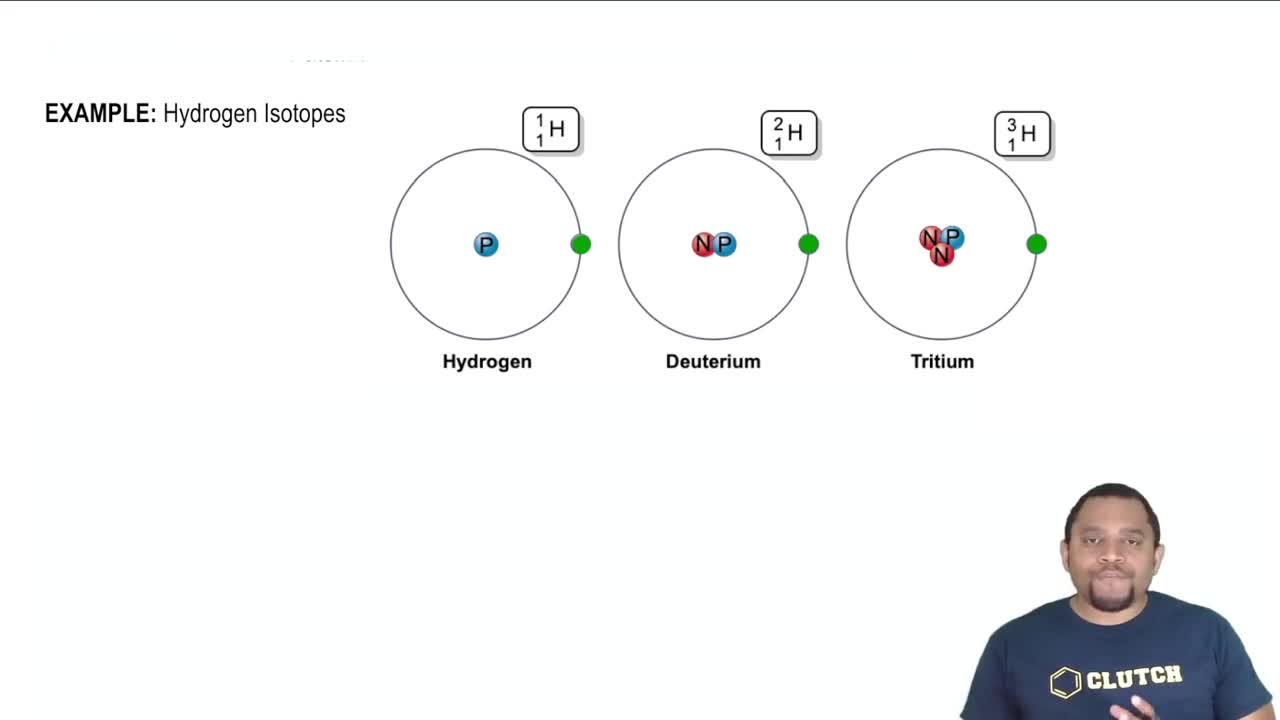
Deuterium labeling involves substituting hydrogen atoms in organic compounds with deuterium, a stable isotope of hydrogen. This process is crucial in tracing reaction pathways and studying mechanisms in organic chemistry. Deuterium can be introduced into molecules using deuterated reagents, such as CD3MgBr, which provides a source of deuterium for the synthesis of labeled compounds.
Recommended video:
Guided course
03:06
Understanding the hydrogen isotopes.

Grignard Reagents

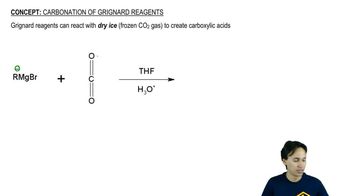
Grignard reagents are organomagnesium compounds that are highly reactive and used to form carbon-carbon bonds in organic synthesis. In this context, CD3MgBr acts as a deuterated Grignard reagent, allowing for the introduction of a deuterated methyl group into a target molecule. Understanding the reactivity and mechanisms of Grignard reagents is essential for successfully synthesizing complex organic compounds.
Recommended video:
Guided course
02:12
Carbonation of Grignard Reagents

Alcohol Synthesis

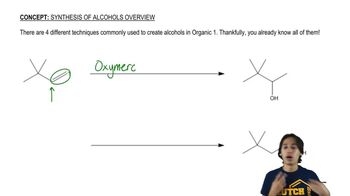
The synthesis of alcohols from alkenes or other functional groups is a fundamental reaction in organic chemistry. In this case, the target compound CD3CH2CH2OH can be synthesized through nucleophilic addition of the deuterated Grignard reagent to a suitable carbonyl compound, followed by hydrolysis with D2O. Recognizing the steps involved in alcohol formation is key to constructing the desired deuterium-labeled compound.
Recommended video:
Guided course
02:26
Forming alcohols through Oxymercuration-Reduction.