Ch.10 - Structure and Synthesis of Alcohols
Wade - Organic Chemistry 9th Edition
Wade9th EditionOrganic ChemistryISBN: 9780135213728Not the one you use?Change textbook
Chapter 10, Problem 55b

Show how to make these deuterium-labeled compounds, using CD3MgBr and D2O as your sources of deuterium, and any non-deuterated starting materials you wish.
b. CH3C(OH)(CD3)2

Verified step by step guidance
1
Start with a non-deuterated ketone, such as acetone (CH3C(O)CH3), as your starting material. Acetone has a carbonyl group that can undergo nucleophilic addition reactions.
React acetone with CD3MgBr (a Grignard reagent containing deuterium). The nucleophilic CD3⁻ group will attack the electrophilic carbonyl carbon of acetone, forming a tetrahedral intermediate.
Protonate the tetrahedral intermediate by adding D2O (deuterium oxide). This step will replace the oxygen atom of the carbonyl group with an OD group, resulting in the formation of CH3C(OD)(CD3)2.
Recognize that the OD group can be converted to an OH group by exchanging the deuterium atom with a hydrogen atom. This can be achieved by treating the compound with a mild acidic or neutral aqueous solution.
The final product is CH3C(OH)(CD3)2, where the two CD3 groups are deuterium-labeled, and the hydroxyl group is non-deuterated.

Verified video answer for a similar problem:

This video solution was recommended by our tutors as helpful for the problem above.
Video duration:
5m
Was this helpful?

Key Concepts

Here are the essential concepts you must grasp in order to answer the question correctly.

Deuterium Labeling

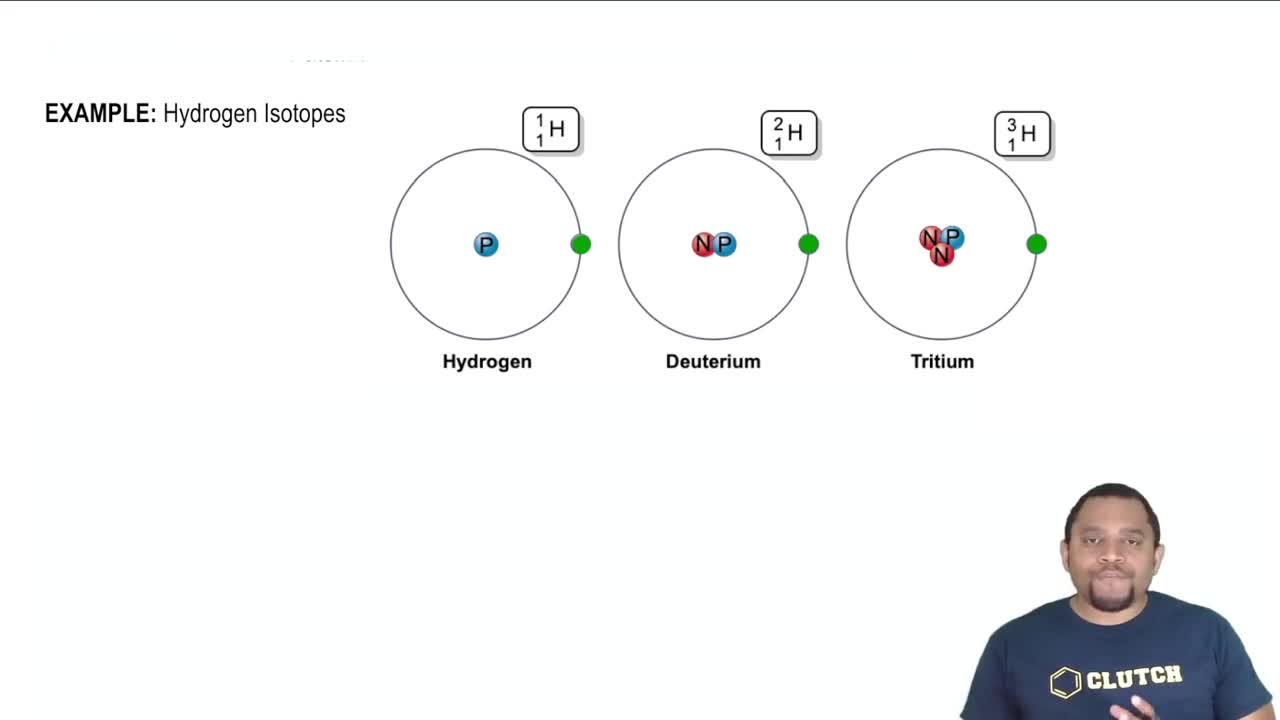
Deuterium labeling involves substituting hydrogen atoms in organic compounds with deuterium, a stable isotope of hydrogen. This process is crucial in tracing the pathways of chemical reactions and understanding molecular structures. In this context, deuterium-labeled compounds can provide insights into reaction mechanisms and kinetics.
Recommended video:
Guided course
03:06
Understanding the hydrogen isotopes.

Grignard Reagents

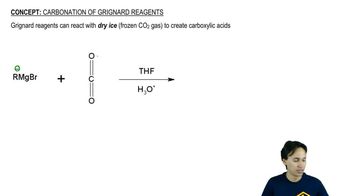
Grignard reagents, such as CD3MgBr, are organomagnesium compounds used in organic synthesis to form carbon-carbon bonds. They react with electrophiles, including carbonyl compounds, to create new carbon centers. Understanding how to utilize Grignard reagents is essential for constructing complex organic molecules, including those with deuterium labels.
Recommended video:
Guided course
02:12
Carbonation of Grignard Reagents

Alcohol Formation

The formation of alcohols from carbonyl compounds is a fundamental reaction in organic chemistry. In this case, the reaction of a Grignard reagent with a carbonyl compound leads to the formation of a tertiary alcohol. Recognizing the mechanisms of alcohol formation, including the role of deuterium in the final product, is vital for synthesizing the desired deuterium-labeled compound.
Recommended video:
Guided course
01:01
How to name alcohols
Related Practice
Textbook Question

Show how to make these deuterium-labeled compounds, using CD3MgBr and D2O as your sources of deuterium, and any non-deuterated starting materials you wish.

c. CD3CH2CH2OH

719
views

Textbook Question

Compounds containing deuterium (D = 2H) are useful for kinetic studies and metabolic studies with new pharmaceuticals. One way to introduce deuterium is by using the reagent LiAlD4, equivalent in reactivity to LiAlH4. Show how to make these deuterium-labeled compounds, using LiAlD4 and D2O as your sources of deuterium, and any non-deuterated starting materials you wish.

(b) CH3CD2OH

843
views
Textbook Question

Show how to make these deuterium-labeled compounds, using CD3MgBr and D2O as your sources of deuterium, and any non-deuterated starting materials you wish.

a. CH3CH(OD)CD3

1692
views
1
comments
Textbook Question

Compounds containing deuterium (D = 2H) are useful for kinetic studies and metabolic studies with new pharmaceuticals. One way to introduce deuterium is by using the reagent LiAlD4, equivalent in reactivity to LiAlH4. Show how to make these deuterium-labeled compounds, using LiAlD4 and D2O as your sources of deuterium, and any non-deuterated starting materials you wish.

(c) CH3CD2OD

636
views
Textbook Question

Show how to make these deuterium-labeled compounds, using CD3MgBr and D2O as your sources of deuterium, and any non-deuterated starting materials you wish.

d. Ph(CD3)2COD

1304
views
Textbook Question

Often, compounds can be synthesized by more than one method. Show how this 3° alcohol can be made from the following:

(a) two different ketones

1368
views