
The following reaction involves a starting material with a double bond and a hydroxy group, yet its mechanism resembles a pinacol rearrangement. Propose a mechanism, and point out the part of your mechanism that resembles a pinacol rearrangement.
Ch.11 - Reactions of Alcohols
Chapter 11, Problem 30a,b
Predict the products formed by periodic acid cleavage of the following diols.
(a) CH3CH(OH)CH(OH)CH3
(b) 
Verified step by step guidance1
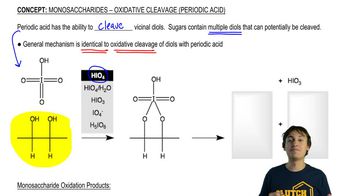
Step 1: Understand the reaction mechanism of periodic acid (HIO4) cleavage. Periodic acid selectively cleaves vicinal diols (two hydroxyl groups on adjacent carbons) to form carbonyl compounds (aldehydes or ketones). This occurs via oxidation of the diol, breaking the C-C bond between the hydroxyl-bearing carbons.
Step 2: Analyze compound (a), CH3CH(OH)CH(OH)CH3. This is a vicinal diol with hydroxyl groups on adjacent carbons. Periodic acid will cleave the bond between the two hydroxyl-bearing carbons, resulting in two ketone products. The methyl groups on either side of the diol remain intact.
Step 3: Examine compound (b) from the image. Identify the vicinal diol structure in the molecule. The hydroxyl groups are located on adjacent carbons in the cyclic structure. Periodic acid will cleave the C-C bond between these two carbons, breaking the ring and forming two carbonyl compounds.
Step 4: Predict the products for compound (b). After cleavage, the cyclic structure opens up, and the two carbons that originally bore the hydroxyl groups are converted into carbonyl groups (aldehydes or ketones). The rest of the molecule remains unchanged.
Step 5: Summarize the periodic acid cleavage process for both compounds. For (a), the cleavage results in two ketones. For (b), the cleavage opens the ring and forms two carbonyl compounds. Ensure the products are consistent with the oxidation of vicinal diols.

Verified video answer for a similar problem:
This video solution was recommended by our tutors as helpful for the problem above.
Video duration:
6mWas this helpful?
Key Concepts
Here are the essential concepts you must grasp in order to answer the question correctly.
Periodic Acid Cleavage
Periodic acid (H5IO6) is a strong oxidizing agent that cleaves vicinal diols (1,2-diols) into carbonyl compounds. The reaction involves the formation of a cyclic periodate intermediate, which subsequently breaks down to yield aldehydes or ketones. Understanding this mechanism is crucial for predicting the products of diol cleavage.
Recommended video:
Guided course
Monosaccharides - Oxidative Cleavage
Vicinal Diols
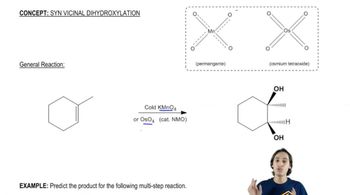
Vicinal diols, also known as glycols, are organic compounds containing two hydroxyl (-OH) groups attached to adjacent carbon atoms. Their structure is essential for the periodic acid cleavage reaction, as the proximity of the hydroxyl groups allows for the formation of the cyclic intermediate that leads to cleavage. Recognizing the structure of the diol is key to predicting the cleavage products.
Recommended video:
Guided course
General properties of syn vicinal dihydroxylation.
Product Prediction
Predicting the products of a chemical reaction involves understanding the reactants' structure and the reaction mechanism. In the case of periodic acid cleavage, one must identify the positions of the hydroxyl groups in the diol and apply the cleavage mechanism to determine the resulting carbonyl compounds. This skill is fundamental in organic chemistry for anticipating reaction outcomes.
Recommended video:
Guided course
Predict the Products
Related Practice
Textbook Question
867
views
Textbook Question
Use resonance forms of the conjugate bases to explain why methanesulfonic acid (CH3SO3H, pKa = –2.6) is a much stronger acid than acetic acid (CH3COOH, pKa = 4.8).
1083
views
Textbook Question
Propose a mechanism for each reaction.
(a)
(b)
1106
views
Textbook Question
Show the alcohol and the acid chloride that combine to make the following esters.
(c)
(d)
725
views
Textbook Question
When the following substituted cycloheptanol undergoes dehydration, one of the minor products has undergone a ring contraction. Propose a mechanism to show how this ring contraction occurs.
1032
views
Textbook Question
Predict the products formed by periodic acid cleavage of the following diols.
(c)
(d)
969
views
