

Ch.11 - Reactions of Alcohols
Wade - Organic Chemistry 9th Edition
Wade9th EditionOrganic ChemistryISBN: 9780135213728Not the one you use?Change textbook
Chapter 11, Problem 30c,d

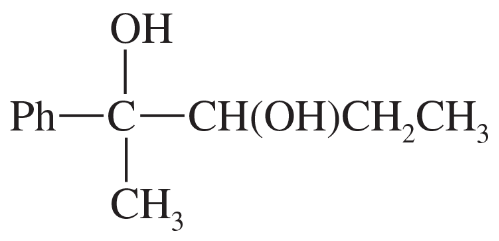
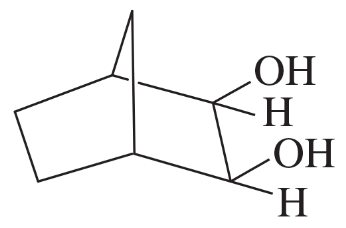
Predict the products formed by periodic acid cleavage of the following diols.
(c)
(d)

Verified step by step guidance
1
Periodic acid (HIO₄) cleaves vicinal diols (diols with hydroxyl groups on adjacent carbons) into carbonyl compounds (aldehydes or ketones). This reaction occurs via oxidative cleavage of the C-C bond between the hydroxyl-bearing carbons.
For structure (c): Identify the vicinal diol. The hydroxyl groups are on adjacent carbons (C1 and C2). The cleavage will break the bond between these two carbons, forming two carbonyl compounds. Analyze the substituents on each carbon to determine whether aldehydes or ketones are formed.
For structure (c): The carbon attached to the phenyl group (Ph) and a methyl group (CH₃) will form a ketone because it is a tertiary carbon. The adjacent carbon (C2), which is part of the ethyl group (CH₂CH₃), will form an aldehyde because it is a primary carbon.
For structure (d): Identify the vicinal diols. The hydroxyl groups are on adjacent carbons in the bicyclic structure. Cleavage will occur at the C-C bond between these carbons, resulting in two carbonyl compounds. Consider the steric and structural arrangement to determine the products.
For structure (d): The cleavage of the diol in the bicyclic system will yield two carbonyl compounds. Depending on the specific arrangement of the substituents, the products will likely include ketones or aldehydes. Carefully analyze the connectivity of the carbons to predict the exact products.

Verified video answer for a similar problem:

This video solution was recommended by our tutors as helpful for the problem above.
Video duration:
6m
Was this helpful?

Key Concepts

Here are the essential concepts you must grasp in order to answer the question correctly.

Periodic Acid Cleavage

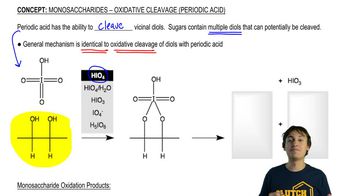
Periodic acid (H5IO6) is a strong oxidizing agent that cleaves vicinal diols (1,2-diols) into carbonyl compounds. This reaction involves the formation of a cyclic periodate intermediate, which subsequently breaks down to yield aldehydes or ketones, depending on the structure of the diol. Understanding this mechanism is crucial for predicting the products of the reaction.
Recommended video:
Guided course
06:41
Monosaccharides - Oxidative Cleavage

Vicinal Diols

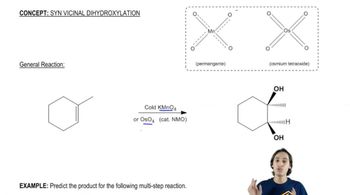
Vicinal diols, also known as glycols, are organic compounds that contain two hydroxyl (-OH) groups attached to adjacent carbon atoms. Their structure is essential for periodic acid cleavage, as the reaction specifically targets these diols. Recognizing the configuration and positioning of the hydroxyl groups helps in determining the expected cleavage products.
Recommended video:
Guided course
03:50
General properties of syn vicinal dihydroxylation.

Oxidation States and Functional Groups

In organic chemistry, understanding oxidation states is vital for predicting the outcome of reactions. During periodic acid cleavage, the oxidation state of the carbon atoms changes as hydroxyl groups are converted into carbonyl groups. Familiarity with functional groups, such as aldehydes and ketones, allows for accurate identification of the products formed from the cleavage of diols.
Recommended video:
Guided course
02:36
Identifying Functional Groups