Ch.11 - Reactions of Alcohols
Wade - Organic Chemistry 9th Edition
Wade9th EditionOrganic ChemistryISBN: 9780135213728Not the one you use?Change textbook
Chapter 11, Problem 22d,e

Predict the products of the sulfuric acid-catalyzed dehydration of the following alcohols. When more than one product is expected, label the major and minor products.
(d) 1-isopropylcyclohexanol
(e) 2-methylcyclohexanol

Verified step by step guidance
1
Step 1: Understand the reaction mechanism. Sulfuric acid-catalyzed dehydration of alcohols typically proceeds via an E1 mechanism for secondary and tertiary alcohols. The reaction involves protonation of the hydroxyl group, formation of a carbocation intermediate, and elimination of water to form an alkene.
Step 2: Analyze the structure of the alcohols. For (d) 1-isopropylcyclohexanol, the hydroxyl group is attached to a secondary carbon. For (e) 2-methylcyclohexanol, the hydroxyl group is also attached to a secondary carbon. Both alcohols will form carbocations upon dehydration.
Step 3: Consider carbocation stability. In (d), the carbocation formed after dehydration will be influenced by the isopropyl group, which provides hyperconjugation and inductive effects to stabilize the carbocation. In (e), the carbocation formed will be stabilized by the methyl group through similar effects.
Step 4: Predict the possible alkenes. For (d), elimination of a proton from adjacent carbons to the carbocation will yield different alkenes. Apply Zaitsev's rule, which states that the more substituted alkene is the major product. For (e), follow the same process to predict the alkenes and identify the major and minor products.
Step 5: Label the major and minor products. Based on Zaitsev's rule, the major product will be the more substituted alkene, while the minor product will be the less substituted alkene. Consider steric and electronic factors to finalize the labeling of major and minor products for both (d) and (e).

Verified video answer for a similar problem:

This video solution was recommended by our tutors as helpful for the problem above.
Video duration:
4m
Was this helpful?

Key Concepts

Here are the essential concepts you must grasp in order to answer the question correctly.

Dehydration of Alcohols

Dehydration of alcohols is a chemical reaction where an alcohol loses a water molecule, typically in the presence of an acid catalyst like sulfuric acid. This process often leads to the formation of alkenes. The reaction can proceed via either an E1 or E2 mechanism, depending on the structure of the alcohol and the reaction conditions, influencing the regioselectivity of the products.
Recommended video:
Guided course
01:23
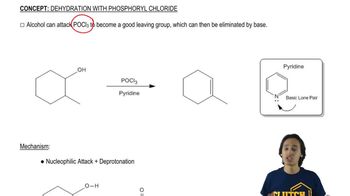
General Reaction of Dehydration with POCl3

Regioselectivity

Regioselectivity refers to the preference of a chemical reaction to yield one structural isomer over others when multiple products are possible. In the dehydration of alcohols, the more stable alkene (often the more substituted one) is typically formed as the major product due to greater stability from hyperconjugation and alkyl substitution, while less stable isomers are considered minor products.
Recommended video:
Guided course
05:09
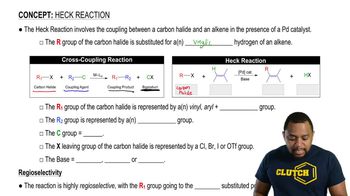
Heck Reaction

Carbocation Stability

Carbocation stability is a key factor in determining the outcome of dehydration reactions. Carbocations are positively charged carbon species that can form during the reaction. Their stability increases with the degree of substitution: tertiary carbocations are more stable than secondary, which are more stable than primary. This stability influences which alkene product is favored in the dehydration process.
Recommended video:
Guided course
05:58
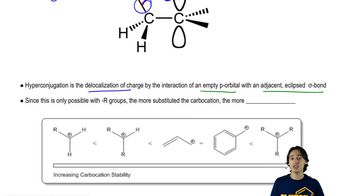
Determining Carbocation Stability
Related Practice
Textbook Question

Explain why the acid-catalyzed condensation is a poor method for the synthesis of an unsymmetrical ether such as ethyl methyl ether, CH3CH2-O-CH3.

1250
views

Textbook Question

Some alcohols undergo rearrangement or other unwanted side reactions when they dehydrate in acid. Alcohols may be dehydrated under mildly basic conditions using phosphorus oxy-chloride (POCl3) in pyridine. The alcohol reacts with phosphorus oxychloride much like it reacts with tosyl chloride (Section 11-5), displacing a chloride ion from phosphorus to give an alkyl dichlorophosphate ester. The dichlorophosphate group is an outstanding leaving group. Pyridine reacts as a base with the dichlorophosphate ester to give an E2 elimination. Propose a mechanism for the dehydration of cyclohexanol by POCl3 in pyridine.

2034
views
Textbook Question

Contrast the mechanisms of the two preceding reactions, the dehydration and condensation of ethanol.

551
views
Textbook Question

Two products are observed in the following reaction.

a. Suggest a mechanism to explain how these two products are formed.

b. Your mechanism for part (a) should be different from the usual mechanism of the reaction of SOCl2 with alcohols. Explain why the reaction follows a different mechanism in this case.

1704
views
Textbook Question

Give the structures of the products you would expect when each alcohol reacts with (1) HCl, ZnCl2; (2) HBr; (3) PBr3; (4) P/I2; and (5) SOCl2.

(a) butan-1-ol

(b) 2-methylbutan-2-ol

1586
views
Textbook Question

Suggest how you would convert trans-4-methylcyclohexanol to

a. trans-1-chloro-4-methylcyclohexane.

b. cis-1-chloro-4-methylcyclohexane.

1405
views