Ch.11 - Reactions of Alcohols
Wade - Organic Chemistry 9th Edition
Wade9th EditionOrganic ChemistryISBN: 9780135213728Not the one you use?Change textbook
Chapter 11, Problem 24a

Contrast the mechanisms of the two preceding reactions, the dehydration and condensation of ethanol.

Verified step by step guidance
1
Understand the two reactions: Dehydration of ethanol involves the removal of a water molecule to form ethene, while condensation of ethanol involves the combination of two ethanol molecules to form a larger molecule (e.g., diethyl ether) with the elimination of water.
For the dehydration mechanism: Recognize that it typically occurs under acidic conditions (e.g., H₂SO₄ or H₃PO₄) and heat. The first step involves protonation of the hydroxyl group (-OH) of ethanol, making it a better leaving group.
In the dehydration mechanism, after protonation, the -OH group leaves as water, forming a carbocation intermediate. This is followed by the elimination of a proton (H⁺) from a neighboring carbon, resulting in the formation of a double bond (ethene).
For the condensation mechanism: This reaction also occurs under acidic conditions but at lower temperatures. The hydroxyl group of one ethanol molecule is protonated, making it a better leaving group. A second ethanol molecule then attacks the carbocation formed, leading to the formation of an ether bond.
In the condensation mechanism, after the nucleophilic attack by the second ethanol molecule, a proton is lost to regenerate the acid catalyst, and the final product (e.g., diethyl ether) is formed along with water as a byproduct.

Verified video answer for a similar problem:

This video solution was recommended by our tutors as helpful for the problem above.
Video duration:
2m
Was this helpful?

Key Concepts

Here are the essential concepts you must grasp in order to answer the question correctly.

Dehydration Reaction

A dehydration reaction involves the removal of a water molecule from a reactant, typically resulting in the formation of a double bond or a new functional group. In the case of ethanol, dehydration can lead to the formation of ethylene (ethene) when heated in the presence of an acid catalyst. This process is crucial in organic synthesis as it helps in the formation of alkenes from alcohols.
Recommended video:
Guided course
01:23
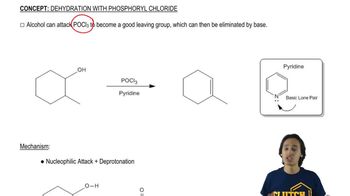
General Reaction of Dehydration with POCl3

Condensation Reaction

A condensation reaction is a chemical process where two molecules combine to form a larger molecule, accompanied by the loss of a small molecule, often water. In the context of ethanol, condensation can occur when two ethanol molecules react to form diethyl ether, releasing water in the process. This type of reaction is fundamental in forming larger organic compounds and polymers.
Recommended video:
Guided course
05:53
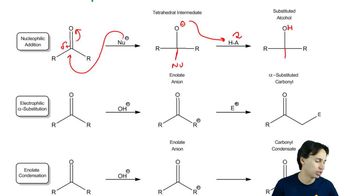
Condensation Reactions

Reaction Mechanisms

Reaction mechanisms describe the step-by-step sequence of elementary reactions by which overall chemical change occurs. Understanding the mechanisms of dehydration and condensation reactions of ethanol involves analyzing the intermediates and transition states formed during the reactions. This knowledge is essential for predicting the products and understanding the conditions required for each reaction.
Recommended video:
Guided course
02:16
Heck Reaction Mechanism