Ch.11 - Reactions of Alcohols
Wade - Organic Chemistry 9th Edition
Wade9th EditionOrganic ChemistryISBN: 9780135213728Not the one you use?Change textbook
Chapter 11, Problem 5d,e

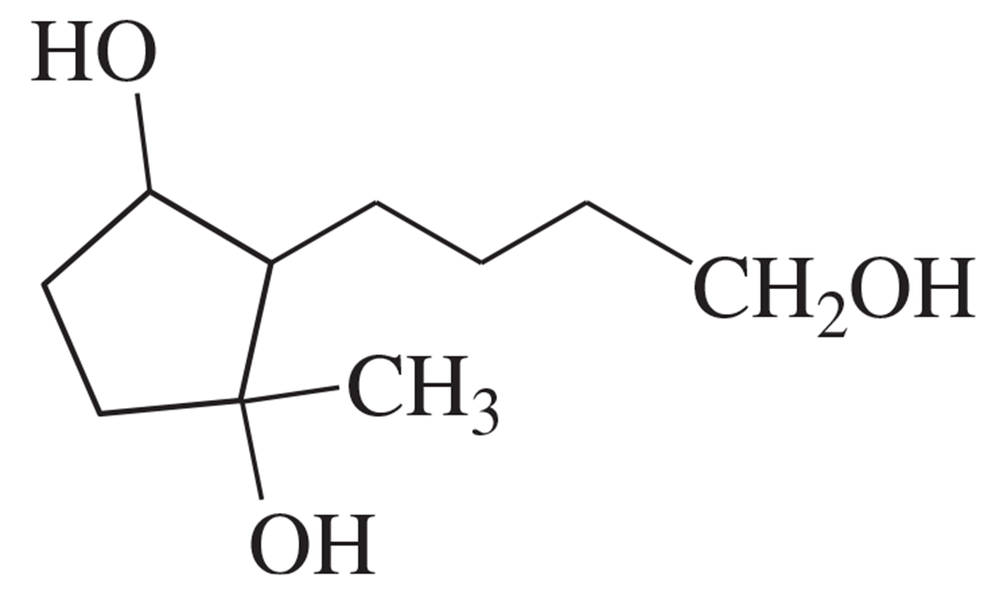
Predict the products you expect when the following starting material undergoes oxidation with an excess of each of the reagents shown below.

d. DMSO and oxalyl chloride
e. DMP (periodinane) reagent

Verified step by step guidance
1
Analyze the structure of the starting material: The molecule contains two primary alcohol groups (-CH2OH) and one secondary alcohol group (-CHOH). These functional groups are susceptible to oxidation under the given conditions.
Understand the role of DMSO and oxalyl chloride (Swern oxidation): This reagent combination selectively oxidizes primary alcohols to aldehydes and secondary alcohols to ketones without over-oxidizing to carboxylic acids.
Predict the product for DMSO and oxalyl chloride: The primary alcohol group (-CH2OH) on the side chain will be oxidized to an aldehyde (-CHO), and the secondary alcohol group (-CHOH) in the ring will be oxidized to a ketone (-C=O). The hydroxyl group (-OH) on the ring that is not part of an alcohol functional group will remain unchanged.
Understand the role of DMP (Dess-Martin periodinane): DMP is a mild oxidizing agent that also selectively oxidizes primary alcohols to aldehydes and secondary alcohols to ketones, similar to Swern oxidation.
Predict the product for DMP: The primary alcohol group (-CH2OH) on the side chain will be oxidized to an aldehyde (-CHO), and the secondary alcohol group (-CHOH) in the ring will be oxidized to a ketone (-C=O). The hydroxyl group (-OH) on the ring that is not part of an alcohol functional group will remain unchanged.

Verified video answer for a similar problem:

This video solution was recommended by our tutors as helpful for the problem above.
Video duration:
2m
Was this helpful?

Key Concepts

Here are the essential concepts you must grasp in order to answer the question correctly.

Oxidation Reactions

Oxidation reactions involve the loss of electrons or an increase in oxidation state by a molecule. In organic chemistry, this often pertains to the conversion of alcohols to carbonyl compounds or further to carboxylic acids. Understanding the specific reagents used in oxidation, such as DMSO and periodinane, is crucial for predicting the products formed.
Recommended video:
Guided course
03:20
Benzylic Oxidation

DMSO and Oxalyl Chloride

DMSO (dimethyl sulfoxide) in combination with oxalyl chloride is a powerful oxidizing system that can convert alcohols to aldehydes or ketones. This reagent pair is particularly effective for transforming primary alcohols into aldehydes without over-oxidation to carboxylic acids, making it essential to recognize the expected product based on the starting material.
Recommended video:
Guided course
03:13
Acid Chloride Nomenclature

DMP (Dess-Martin Periodinane)

DMP, or Dess-Martin periodinane, is a mild and selective oxidizing agent used primarily for the oxidation of alcohols to aldehydes and ketones. It is favored for its ability to perform these transformations under mild conditions, minimizing side reactions. Understanding its selectivity helps in predicting the outcome of oxidation reactions involving various alcohols.