Explain why the acid-catalyzed condensation is a poor method for the synthesis of an unsymmetrical ether such as ethyl methyl ether, CH3CH2-O-CH3.
Ch.11 - Reactions of Alcohols
Chapter 11, Problem 26c
Propose a mechanism for each reaction.
(c) 
Verified step by step guidance1
Step 1: Recognize the reaction type. This reaction involves dehydration of an alcohol (CH2OH group) under acidic conditions (H2SO4 and heat). The goal is to remove water and form alkenes as products.
Step 2: Protonation of the alcohol group. The sulfuric acid (H2SO4) donates a proton (H+) to the hydroxyl group (-OH) of the alcohol, converting it into a better leaving group (H2O). This step increases the reactivity of the molecule.
Step 3: Formation of a carbocation intermediate. The water molecule leaves, generating a carbocation at the carbon where the alcohol group was attached. This carbocation is the key intermediate in the reaction.
Step 4: Rearrangement and elimination. The carbocation can undergo rearrangement to form more stable carbocations if possible. Then, elimination occurs where a proton is removed from a neighboring carbon atom, leading to the formation of double bonds (alkenes).
Step 5: Formation of multiple products. Depending on the position of the double bond and the stability of the resulting alkenes, multiple products can form. In this case, the products are cyclopentene, methylenecyclopentane, and 1-methylcyclopentene.

Verified video answer for a similar problem:
This video solution was recommended by our tutors as helpful for the problem above.
Video duration:
12mWas this helpful?
Key Concepts
Here are the essential concepts you must grasp in order to answer the question correctly.
Reaction Mechanism
A reaction mechanism is a step-by-step description of how reactants transform into products in a chemical reaction. It outlines the sequence of elementary steps, including bond breaking and formation, and the intermediates formed during the process. Understanding the mechanism is crucial for predicting the outcome of reactions and for designing new synthetic pathways.
Recommended video:
Guided course
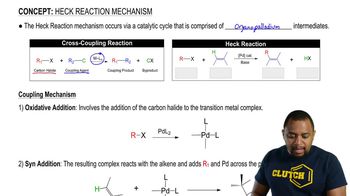
Heck Reaction Mechanism
Types of Organic Reactions
Organic reactions can be classified into several types, including substitution, addition, elimination, and rearrangement reactions. Each type has distinct characteristics and mechanisms. Recognizing the type of reaction helps in predicting the behavior of reactants and the nature of the products formed, which is essential for proposing accurate mechanisms.
Recommended video:
Guided course
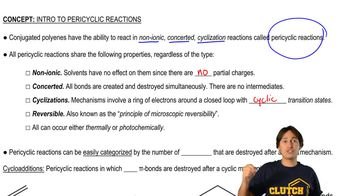
Properties and Types of Pericyclic Reactions
Curved Arrow Notation
Curved arrow notation is a visual representation used in organic chemistry to illustrate the movement of electrons during a reaction. Arrows indicate the direction of electron flow, showing how bonds are broken and formed. Mastery of this notation is vital for accurately depicting reaction mechanisms and understanding the underlying electronic changes that occur.
Recommended video:
Guided course
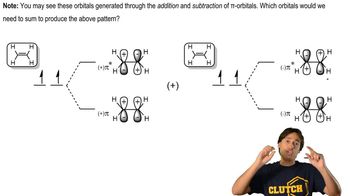
Alternative MO Notation for Dienes
Related Practice
Textbook Question
1250
views
Textbook Question
Propose a mechanism for each reaction.
(a)
1162
views
Textbook Question
The following reaction involves a starting material with a double bond and a hydroxy group, yet its mechanism resembles a pinacol rearrangement. Propose a mechanism, and point out the part of your mechanism that resembles a pinacol rearrangement.
867
views
Textbook Question
Contrast the mechanisms of the two preceding reactions, the dehydration and condensation of ethanol.
551
views
Textbook Question
Propose a mechanism for each reaction.
(a)
(b)
1106
views
Textbook Question
When the following substituted cycloheptanol undergoes dehydration, one of the minor products has undergone a ring contraction. Propose a mechanism to show how this ring contraction occurs.
1032
views