Ch. 12 - Infrared Spectroscopy and Mass Spectrometry
Wade - Organic Chemistry 9th Edition
Wade9th EditionOrganic ChemistryISBN: 9780135213728Not the one you use?Change textbook
Chapter 12, Problem 7

Identify which of these four mass spectra indicate the presence of sulfur, chlorine, bromine, iodine, or nitrogen. Suggest a molecular formula for each.
<IMAGE>

Verified step by step guidance
1
Examine the mass spectrum provided. Identify the molecular ion peak (M+) which represents the molecular weight of the compound. This is typically the highest m/z value with significant intensity.
Look for isotopic patterns that are characteristic of specific elements. For example, chlorine and bromine exhibit distinct isotopic patterns due to their natural abundance (e.g., Cl-35 and Cl-37, Br-79 and Br-81).
Determine if the spectrum shows evidence of sulfur. Sulfur has a minor isotope (S-34) that can create a small peak at +2 m/z relative to the main molecular ion peak.
Check for nitrogen by applying the nitrogen rule. If the molecular ion peak has an odd m/z value, the compound likely contains an odd number of nitrogen atoms.
Suggest a molecular formula based on the molecular ion peak and any isotopic patterns observed. Use the molecular weight and elemental clues to propose a plausible formula.

Verified video answer for a similar problem:

This video solution was recommended by our tutors as helpful for the problem above.
Video duration:
6m
Was this helpful?

Key Concepts

Here are the essential concepts you must grasp in order to answer the question correctly.

Mass Spectrometry

Mass spectrometry is an analytical technique used to measure the mass-to-charge ratio of ions. It provides information about the molecular weight and structure of compounds by generating a mass spectrum, which displays the abundance of detected ions as a function of their mass-to-charge ratio (m/z). This technique is crucial for identifying the presence of specific elements in a sample based on their characteristic mass peaks.
Recommended video:
Guided course
01:25
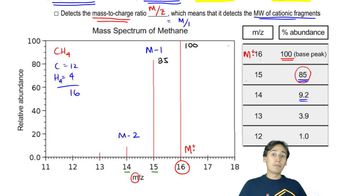
How to Read a Mass Spectrum

Isotopic Patterns

Isotopic patterns refer to the distribution of isotopes of an element in a mass spectrum. Elements like chlorine, bromine, and iodine have distinct isotopic signatures that can be identified by their characteristic peak ratios. For example, chlorine typically shows a 3:1 ratio of peaks corresponding to its isotopes (35Cl and 37Cl), while bromine shows a 1:1 ratio for its isotopes (79Br and 81Br), aiding in the identification of these elements in a compound.
Recommended video:
Guided course
08:06
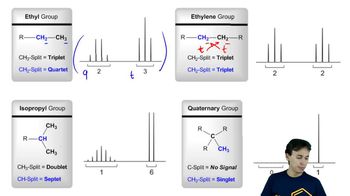
Common Splitting Patterns

Molecular Formula Determination

Determining a molecular formula involves analyzing the mass spectrum to deduce the elemental composition of a compound. By identifying the m/z values of the significant peaks and their corresponding isotopes, one can infer the presence of specific elements such as sulfur, chlorine, bromine, iodine, or nitrogen. This process often includes calculating the ratio of the detected ions to propose a plausible molecular formula that matches the observed data.
Recommended video:
Guided course
02:17
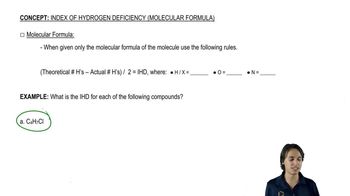
How to use IHD with molecular formula.
Related Practice
Textbook Question

Which of the bonds shown in red are expected to have IR-active stretching frequencies?

2246
views

Textbook Question

Ethers are not easily differentiated by their infrared spectra, but they tend to form predictable fragments in the mass spectrum. The following compounds give similar but distinctive mass spectra.

Both compounds give prominent peaks at m/z 116, 73, 57, and 43. But one compound gives a distinctive strong peak at 87, and the other compound gives a strong peak at 101. Determine which compound gives the peak at 87 and which one gives the peak at 101. Propose fragmentations to account for the ions at m/z 116, 101, 87, and 73.

1489
views
Textbook Question

Show the fragmentations that give rise to the peaks at m/z 43, 57, and 85 in the mass spectrum of 2,4-dimethylpentane (Figure 12-17).

<IMAGE>

2288
views
Textbook Question

The infrared spectra for three compounds are provided. Each compound has one or more of the following functional groups: conjugated ketone, ester, amide, nitrile, and alkyne. Determine the functional group(s) in each compound, and assign the major peaks above 1600 cm–1.

<IMAGE>

1441
views
Textbook Question

Account for the peaks at m/z 87, 111, and 126 in the mass spectrum of 2,6-dimethylheptan-4-ol.

<IMAGE>

2123
views
Textbook Question

Spectra are given for three compounds. Each compound has one or more of the following functional groups: alcohol, amine, ketone, aldehyde, and carboxylic acid. Determine the functional group(s) in each compound, and assign the major peaks above 1600 cm–1.

<IMAGE>

1428
views