Ch. 12 - Infrared Spectroscopy and Mass Spectrometry
Wade - Organic Chemistry 9th Edition
Wade9th EditionOrganic ChemistryISBN: 9780135213728Not the one you use?Change textbook
Chapter 12, Problem 2

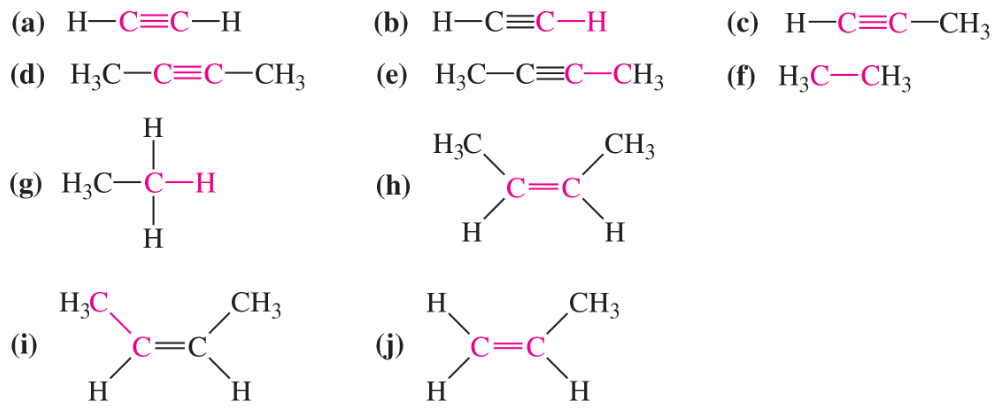
Which of the bonds shown in red are expected to have IR-active stretching frequencies?

Verified step by step guidance
1
Step 1: Understand the concept of IR-active bonds. A bond is IR-active if it has a dipole moment that changes during vibration. Symmetrical bonds or bonds with no dipole moment are typically IR-inactive.
Step 2: Analyze each structure provided in the images. Look for bonds shown in red or pink and determine if they involve atoms with differing electronegativities, which would create a dipole moment.
Step 3: For each bond, consider the symmetry of the molecule. If the bond is part of a symmetrical structure, it may not have a dipole moment change during vibration, making it IR-inactive.
Step 4: Evaluate the functional groups present. For example, triple bonds (C≡C) and double bonds (C=C) can be IR-active if they are part of an asymmetrical environment or involve polar bonds.
Step 5: Determine which bonds are IR-active based on the above criteria. For example, bonds like H-C≡C-H (structure a) are IR-active because the C-H bond has a dipole moment that changes during vibration, while symmetrical bonds like C≡C in a symmetrical environment may be IR-inactive.

Verified video answer for a similar problem:

This video solution was recommended by our tutors as helpful for the problem above.
Video duration:
7m
Was this helpful?

Key Concepts

Here are the essential concepts you must grasp in order to answer the question correctly.

Infrared (IR) Spectroscopy

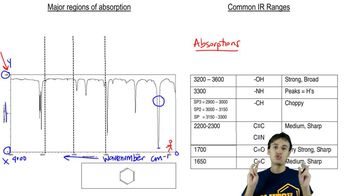
Infrared spectroscopy is a technique used to identify molecular structures by measuring the absorption of infrared light, which causes molecular vibrations. Different types of bonds absorb IR radiation at characteristic frequencies, allowing chemists to deduce the presence of specific functional groups in a compound.
Recommended video:
Guided course
16:04
General Features of IR Spect

Molecular Vibrations

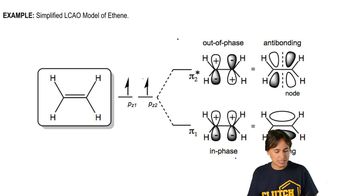
Molecular vibrations refer to the oscillations of atoms within a molecule around their equilibrium positions. These vibrations can be stretching (lengthening or shortening of bonds) or bending (change in bond angles), and only certain vibrations lead to changes in the dipole moment, making them IR-active.
Recommended video:
Guided course
08:41
Review of Molecular Orbitals

IR-Active vs. IR-Inactive Bonds

A bond is considered IR-active if its vibration results in a change in the dipole moment of the molecule. For example, polar bonds typically exhibit IR activity, while symmetrical nonpolar bonds do not. Understanding which bonds are IR-active is crucial for interpreting IR spectra and identifying functional groups.
Recommended video:
Guided course
16:47
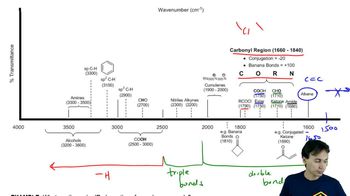
Common IR Frequencies