
Ch. 13 - Nuclear Magnetic Resonance Spectroscopy
Wade - Organic Chemistry 9th Edition
Wade9th EditionOrganic ChemistryISBN: 9780135213728Not the one you use?Change textbook
Chapter 13, Problem 8a

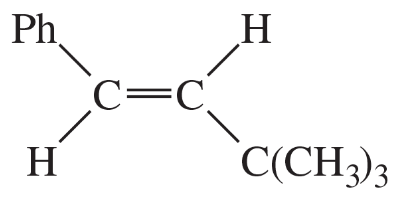
Draw the NMR spectra you expect for the following compounds.
(a)

Verified step by step guidance
1
Step 1: Analyze the molecular structure of the compound. The compound contains a phenyl group (Ph), a hydrogen atom (H), and a tert-butyl group (C(CH3)3) attached to a double bond (C=C). This structure suggests distinct environments for the hydrogens in the molecule.
Step 2: Identify the unique proton environments. The molecule has three types of protons: (1) the vinyl proton attached to the double bond (H-C=C), (2) the phenyl protons (aromatic hydrogens), and (3) the protons in the tert-butyl group (methyl hydrogens).
Step 3: Predict the chemical shifts for each proton environment. (1) The vinyl proton will appear downfield due to the electron-withdrawing effect of the double bond, typically around 5-7 ppm. (2) The aromatic protons will appear in the range of 6-8 ppm due to the deshielding effect of the aromatic ring. (3) The tert-butyl protons will appear upfield, around 0.9-1.5 ppm, as they are shielded by the electron-donating alkyl group.
Step 4: Determine the splitting patterns. (1) The vinyl proton will likely show a doublet due to coupling with the adjacent hydrogen on the double bond. (2) The aromatic protons will show a complex splitting pattern due to coupling within the phenyl ring. (3) The tert-butyl protons will appear as a singlet because all nine protons are equivalent and there is no coupling.
Step 5: Consider the integration of peaks. The integration will reflect the relative number of protons in each environment: (1) one vinyl proton, (2) five aromatic protons, and (3) nine tert-butyl protons. This information helps in constructing the NMR spectrum.

Verified video answer for a similar problem:

This video solution was recommended by our tutors as helpful for the problem above.
Video duration:
6m
Was this helpful?

Key Concepts

Here are the essential concepts you must grasp in order to answer the question correctly.

Nuclear Magnetic Resonance (NMR) Spectroscopy

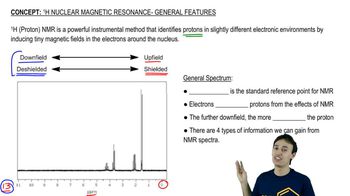
NMR spectroscopy is a powerful analytical technique used to determine the structure of organic compounds. It relies on the magnetic properties of certain nuclei, primarily hydrogen (1H) and carbon (13C), to provide information about the number of hydrogen atoms, their environment, and connectivity in a molecule. The resulting spectra display peaks that correspond to different chemical environments, allowing chemists to deduce structural information.
Recommended video:
Guided course
10:06
General NMR Features

Chemical Shifts

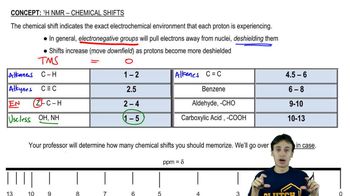
Chemical shifts in NMR spectra indicate the resonance frequency of nuclei relative to a standard reference, typically tetramethylsilane (TMS). The position of these peaks, measured in parts per million (ppm), reflects the electronic environment surrounding the nuclei. For example, protons attached to sp2 hybridized carbons, such as those in alkenes, typically resonate downfield (higher ppm) compared to those on sp3 hybridized carbons, providing insight into the molecular structure.
Recommended video:
Guided course
11:44
1H NMR Chemical Shifts

Integration and Multiplicity

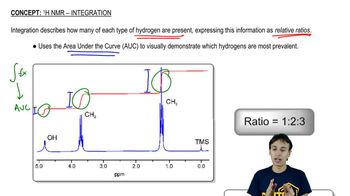
Integration in NMR refers to the area under the peaks, which correlates to the number of protons contributing to that signal. Multiplicity, determined by the splitting of peaks, provides information about neighboring hydrogen atoms through the n+1 rule, where n is the number of adjacent protons. Understanding integration and multiplicity is crucial for interpreting the NMR spectrum and deducing the number of hydrogen atoms and their arrangement in the compound.
Recommended video:
Guided course
06:46
1H NMR Integration