
The NMR spectrum of toluene (methylbenzene) was shown in Figure 13-11.
<IMAGE>
(a) How many different kinds of protons are there in toluene?
(b) Explain why the aromatic region around d7.2 is broad, with more than one sharp absorption.
Verified step by step guidance
The NMR spectrum of toluene (methylbenzene) was shown in Figure 13-11.
<IMAGE>
(a) How many different kinds of protons are there in toluene?
(b) Explain why the aromatic region around d7.2 is broad, with more than one sharp absorption.
Determine the number of different kinds of protons in each compound.
(a) 1-chloropropane
(b) 2-chloropropane
(c) 2,2-dimethylbutane
Propose a structure that corresponds to each spectrum.
(a) <IMAGE>
Draw a splitting tree, similar to Figures 13-32 and 13-33, for proton Hc in styrene. What is the chemical shift of proton Hc?
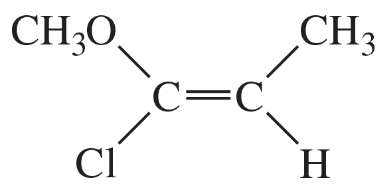
An unknown compound (C3H2NCl) shows moderately strong IR absorptions around 1650 cm–1 and 2200 cm–1. Its NMR spectrum consists of two doublets (J = 14 Hz) at δ5.9 and δ7.1. Propose a structure consistent with these data.
Draw the NMR spectra you expect for the following compounds.
(a)