Ch. 14 - Ethers, Epoxides, and Thioethers
Wade - Organic Chemistry 9th Edition
Wade9th EditionOrganic ChemistryISBN: 9780135213728Not the one you use?Change textbook
Chapter 14, Problem 33a,b,c

Predict the products of the following reactions.
(a) sec-butyl isopropyl ether + concd. HBr, heat
(b) 2-ethoxy-2-methylpentane + concd. HBr, heat
(c) di-n-butyl ether + hot concd. NaOH

Verified step by step guidance
1
Step 1: Understand the reaction mechanism for ethers with concentrated HBr under heat. Ethers typically undergo cleavage in the presence of concentrated HBr, producing alkyl halides and alcohols. The cleavage can proceed via SN1 or SN2 mechanisms depending on the structure of the alkyl groups attached to the oxygen atom.
Step 2: For part (a), sec-butyl isopropyl ether reacts with concentrated HBr under heat. Analyze the structure of the ether: sec-butyl and isopropyl groups are attached to the oxygen atom. Determine which group will undergo cleavage based on steric hindrance and stability of the carbocation (if SN1 mechanism is favored). Predict the products: one will be an alkyl bromide, and the other will be an alcohol.
Step 3: For part (b), 2-ethoxy-2-methylpentane reacts with concentrated HBr under heat. This ether has a tertiary carbon attached to the oxygen atom. Tertiary carbons favor the SN1 mechanism due to the stability of the carbocation formed. Predict the cleavage products: one will be a tertiary alkyl bromide, and the other will be ethanol.
Step 4: For part (c), di-n-butyl ether reacts with hot concentrated NaOH. Unlike acidic cleavage, NaOH provides a basic environment. Ethers are generally resistant to cleavage under basic conditions, but if cleavage occurs, it may involve nucleophilic attack by hydroxide ions. Predict the products based on the reaction mechanism and the structure of di-n-butyl ether.
Step 5: Summarize the predicted products for each reaction based on the mechanisms discussed. Ensure you understand the role of steric effects, carbocation stability, and the nature of the reagents (acidic or basic) in determining the outcome of the reactions.

Verified video answer for a similar problem:

This video solution was recommended by our tutors as helpful for the problem above.
Video duration:
13m
Was this helpful?

Key Concepts

Here are the essential concepts you must grasp in order to answer the question correctly.

Ether Cleavage

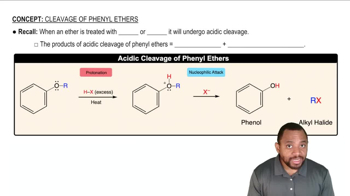
Ether cleavage is a reaction where ethers are broken down into their constituent alcohols and alkyl halides, typically in the presence of strong acids like HBr. The mechanism often involves protonation of the ether oxygen, making it a better leaving group, followed by nucleophilic attack by the halide ion. This process is crucial for predicting the products of reactions involving ethers.
Recommended video:
1:45
Cleavage of Phenyl Ethers Concept 1

Rearrangement Reactions

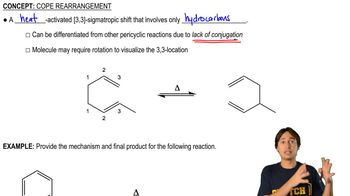
Rearrangement reactions occur when a molecule undergoes a structural change to form a more stable product. In the context of ether cleavage, the formation of more stable carbocations can lead to unexpected products. Understanding how carbocation stability influences product formation is essential for predicting the outcomes of reactions involving branched ethers.
Recommended video:
Guided course
06:28
Definition of Cope Rearrangement

Nucleophilic Substitution

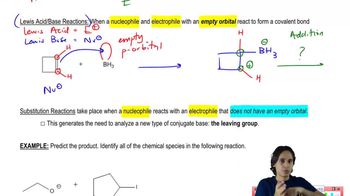
Nucleophilic substitution is a fundamental reaction mechanism in organic chemistry where a nucleophile replaces a leaving group in a molecule. In the case of ether cleavage with strong acids, the nucleophile (often a halide ion) attacks the carbon atom bonded to the leaving group, leading to the formation of new products. Recognizing the type of nucleophilic substitution (SN1 or SN2) is vital for predicting the reaction pathway and products.
Recommended video:
Guided course
01:47
Nucleophiles and Electrophiles can react in Substitution Reactions.