Ch. 14 - Ethers, Epoxides, and Thioethers
Wade - Organic Chemistry 9th Edition
Wade9th EditionOrganic ChemistryISBN: 9780135213728Not the one you use?Change textbook
Chapter 14, Problem 33j,k,l

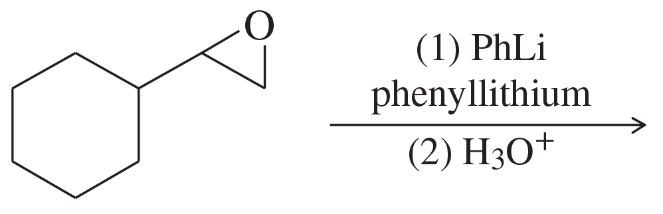
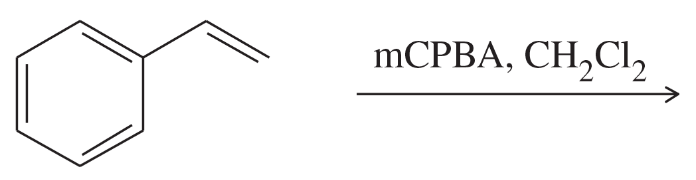
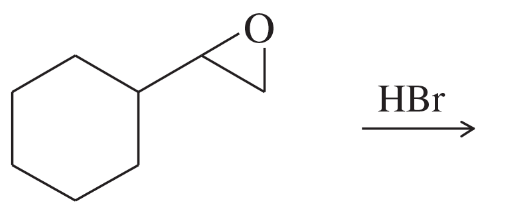
Predict the products of the following reactions.
(j)
(k)
(l)

Verified step by step guidance
1
Step 1 (Reaction j): Analyze the reaction conditions. Phenyl lithium (PhLi) is a strong nucleophile and base. It will attack the electrophilic carbon of the epoxide ring, opening the ring. The acidic workup (H3O+) will protonate the oxygen atom, forming an alcohol.
Step 2 (Reaction j): Determine the regioselectivity of the epoxide ring opening. Under basic conditions, the nucleophile attacks the less substituted carbon of the epoxide due to steric hindrance.
Step 3 (Reaction k): Examine the reaction conditions. mCPBA (meta-chloroperoxybenzoic acid) is a peracid used to convert alkenes into epoxides. The reaction occurs via electrophilic addition to the double bond.
Step 4 (Reaction k): Predict the stereochemistry of the epoxide formation. mCPBA typically forms epoxides with retention of the alkene's stereochemistry, resulting in a syn addition.
Step 5 (Reaction l): Analyze the reaction conditions. HBr reacts with epoxides via an acid-catalyzed ring-opening mechanism. The bromide ion (Br⁻) acts as a nucleophile, attacking the more substituted carbon of the epoxide due to the carbocation-like intermediate formed under acidic conditions.

Verified video answer for a similar problem:

This video solution was recommended by our tutors as helpful for the problem above.
Video duration:
9m
Was this helpful?

Key Concepts

Here are the essential concepts you must grasp in order to answer the question correctly.

Nucleophilic Addition

Nucleophilic addition is a fundamental reaction in organic chemistry where a nucleophile attacks an electrophilic carbon atom, typically found in carbonyl compounds. In this case, phenyl lithium (PhLi) acts as a strong nucleophile, attacking the carbonyl carbon of the ketone, leading to the formation of an alkoxide intermediate.
Recommended video:
Guided course
08:27
Nucleophilic Addition

Reactivity of Organolithium Reagents

Organolithium reagents, such as phenyl lithium, are highly reactive and serve as strong nucleophiles in organic synthesis. They can effectively add to electrophilic centers, such as carbonyl groups, resulting in the formation of new carbon-carbon bonds. Their reactivity is crucial for the transformation of ketones into alcohols after subsequent protonation.
Recommended video:

Protonation of Alkoxides

After the nucleophilic addition of phenyl lithium to the carbonyl compound, the resulting alkoxide intermediate is typically protonated to yield the final alcohol product. This step is often facilitated by adding a proton source, such as H3O+, which donates a proton to the negatively charged oxygen, converting the alkoxide into a stable alcohol.
Recommended video:
Guided course
03:
Proton Splitting
Related Practice
Textbook Question

Show how you would make the following ethers, using only simple alcohols and any needed reagents as your starting materials.

(a) 1-methoxybutane

(b) 2-ethoxy-2-methylpropane

(c) benzyl cyclopentyl ether

1291
views
1
rank

Textbook Question

Give IUPAC names for the following compounds.

(g)

(h)

(i)

970
views
Textbook Question

(A true story.) An inexperienced graduate student moved into a laboratory and began work. He needed some diethyl ether for a reaction, so he opened an old, rusty 1-gallon can marked 'ethyl ether' and found there was half a gallon left. To purify the ether, the student set up a distillation apparatus, started a careful distillation, and went to the stockroom for the other reagents he needed. While he was at the stockroom, the student heard a muffled "boom." He quickly returned to his lab to find a worker from another laboratory putting out a fire. Most of the distillation apparatus was embedded in the ceiling.

(a) Explain what probably happened.

(b) Explain how this near-disaster might have been prevented.

1202
views
Textbook Question

Predict the products of the following reactions.

(a) sec-butyl isopropyl ether + concd. HBr, heat

(b) 2-ethoxy-2-methylpentane + concd. HBr, heat

(c) di-n-butyl ether + hot concd. NaOH

1820
views
1
rank
Textbook Question

Predict the products of the following reactions.

(g) trans-2,3-epoxyoctane + H+, H2O

(h) propylene oxide + methylamine (CH3NH2)

1291
views
Textbook Question

Predict the products of the following reactions.

(m)

(n)

1780
views