
Ch. 14 - Ethers, Epoxides, and Thioethers
Wade - Organic Chemistry 9th Edition
Wade9th EditionOrganic ChemistryISBN: 9780135213728Not the one you use?Change textbook
Chapter 14, Problem 20a,b,c

Show how you would accomplish the following transformations. Some of these examples require more than one step.
(a) 2-methylpropene → 2,2-dimethyloxirane
(b) 1-phenylethanol → 2-phenyloxirane
(c) 5-chloropent-1-ene → tetrahydropyran

Verified step by step guidance
1
Step 1 (a): Begin with 2-methylpropene. Perform an epoxidation reaction by reacting it with a peracid, such as m-chloroperoxybenzoic acid (mCPBA). This will form an epoxide (oxirane) ring across the double bond, resulting in 2,2-dimethyloxirane.
Step 2 (b): Start with 1-phenylethanol. First, oxidize the alcohol group (-OH) to a ketone group (-C=O) using an oxidizing agent like PCC (Pyridinium chlorochromate). This will yield acetophenone (1-phenylethanone).
Step 3 (b): Next, perform a reaction with a peracid (e.g., mCPBA) to epoxidize the ketone. This will form 2-phenyloxirane by creating an epoxide ring across the carbonyl group and the adjacent carbon.
Step 4 (c): Begin with 5-chloropent-1-ene. Perform an intramolecular nucleophilic substitution reaction. Treat the compound with a strong base, such as sodium hydroxide (NaOH), to deprotonate the hydroxyl group and form an alkoxide ion.
Step 5 (c): The alkoxide ion will attack the electrophilic carbon of the alkyl halide (chlorine-bearing carbon), resulting in the formation of a six-membered cyclic ether (tetrahydropyran) through an SN2 mechanism.

Verified video answer for a similar problem:

This video solution was recommended by our tutors as helpful for the problem above.
Video duration:
15m
Was this helpful?

Key Concepts

Here are the essential concepts you must grasp in order to answer the question correctly.

Electrophilic Addition Reactions

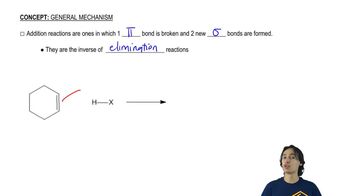
Electrophilic addition reactions involve the addition of electrophiles to alkenes, where the double bond acts as a nucleophile. This is a fundamental reaction type in organic chemistry, allowing for the transformation of alkenes into more complex structures. Understanding how to manipulate the regioselectivity and stereochemistry during these reactions is crucial for achieving desired products.
Recommended video:
Guided course
05:39
Features of Addition Mechanisms.

Epoxidation

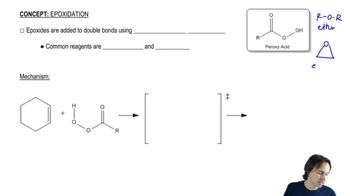
Epoxidation is the process of converting alkenes into epoxides, which are three-membered cyclic ethers. This transformation typically involves the use of peracids, such as m-chloroperbenzoic acid (MCPBA). The formation of epoxides is significant due to their reactivity and utility in further synthetic transformations, including ring-opening reactions.
Recommended video:
Guided course
02:19
General properties of epoxidation.

Ring-Closing Reactions

Ring-closing reactions are processes that form cyclic compounds from acyclic precursors, often involving the formation of new carbon-carbon bonds. In the context of the transformations mentioned, understanding how to manipulate functional groups and reaction conditions to facilitate cyclization is essential. This concept is particularly relevant for synthesizing compounds like tetrahydropyran from linear alkenes.
Recommended video:
Guided course
04:34
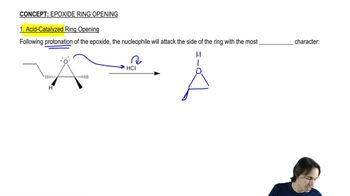
Acid-Catalyzed Epoxide Ring-Opening
Related Practice
Textbook Question

The 2001 Nobel Prize in Chemistry was awarded to three organic chemists who have developed methods for catalytic asymmetric syntheses. An asymmetric (or enantioselective) synthesis is one that converts an achiral starting material into mostly one enantiomer of a chiral product. K. Barry Sharpless (The Scripps Research Institute) developed an asymmetric epoxidation of allylic alcohols that gives excellent chemical yields and greater than 90% enantiomeric excess.

The Sharpless epoxidation uses tert-butyl hydroperoxide, titanium(IV) isopropoxide, and a dialkyl tartrate ester as the reagents. The following epoxidation of geraniol is typical.

(a) Which of these reagents is most likely to be the actual oxidizing agent? That is, which reagent is reduced in the reaction? What is the likely function of the other reagents?

(b) When achiral reagents react to give a chiral product, that product is normally formed as a racemic mixture of enantiomers. How can the Sharpless epoxidation give just one nearly pure enantiomer of the product?

(c) Draw the other enantiomer of the product. What reagents would you use if you wanted to epoxidize geraniol to give this other enantiomer?

1280
views
Textbook Question

Show how you would accomplish the following transformations. Some of these examples require more than one step.

(e) 2-chlorohexan-1-ol → 1,2-epoxyhexane

515
views
Textbook Question

Show how you would use a protecting group to convert 4-bromobutan-1-ol to hept-5-yn-1-ol.

1196
views
Textbook Question

Show how you would synthesize butyl isopropyl sulfide using butan-1-ol, propan-2-ol, and any solvents and reagents you need.

1108
views
Textbook Question

Show how you would accomplish the following transformations. Some of these examples require more than one step.

(d) 5-chloropent-1-ene → 2-methyltetrahydrofuran 

968
views
Textbook Question

Mustard gas, Cl–CH2CH2–S–CH2CH2–Cl, was used as a poisonous chemical agent in World War I. Mustard gas is much more toxic than a typical primary alkyl chloride. Its toxicity stems from its ability to alkylate amino groups on important metabolic enzymes, rendering the enzymes inactive.

a. Propose a mechanism to explain why mustard gas is an exceptionally potent alkylating agent.

b. Bleach (sodium hypochlorite, NaOCl, a strong oxidizing agent) neutralizes and inactivates mustard gas. Bleach is also effective on organic stains because it oxidizes colored compounds to colorless compounds. Propose products that might be formed by the reaction of mustard gas with bleach.

1173
views