Ch. 14 - Ethers, Epoxides, and Thioethers
Wade - Organic Chemistry 9th Edition
Wade9th EditionOrganic ChemistryISBN: 9780135213728Not the one you use?Change textbook
Chapter 14, Problem 19

Show how you would use a protecting group to convert 4-bromobutan-1-ol to hept-5-yn-1-ol.

Verified step by step guidance
1
Step 1: Identify the functional groups in 4-bromobutan-1-ol. The molecule contains both a hydroxyl (-OH) group and a bromine atom (-Br). The hydroxyl group needs to be protected to prevent unwanted reactions during the subsequent steps.
Step 2: Choose an appropriate protecting group for the hydroxyl group. A common choice is the silyl ether, such as tert-butyldimethylsilyl (TBDMS) chloride, which reacts with the hydroxyl group in the presence of a base like imidazole to form a protected silyl ether.
Step 3: Perform the protection reaction. React 4-bromobutan-1-ol with TBDMS chloride and imidazole to convert the hydroxyl group into a TBDMS-protected silyl ether. This prevents the hydroxyl group from interfering in subsequent reactions.
Step 4: Carry out the substitution reaction to replace the bromine atom (-Br) with a terminal alkyne group (-C≡CH). Use a reagent like sodium acetylide (NaC≡CH) in a suitable solvent to perform the nucleophilic substitution reaction, forming hept-5-yn-1-TBDMS ether.
Step 5: Remove the protecting group to regenerate the hydroxyl group. Use a mild acid or fluoride source, such as tetrabutylammonium fluoride (TBAF), to deprotect the silyl ether and yield the final product, hept-5-yn-1-ol.

Verified video answer for a similar problem:

This video solution was recommended by our tutors as helpful for the problem above.
Video duration:
7m
Was this helpful?

Key Concepts

Here are the essential concepts you must grasp in order to answer the question correctly.

Protecting Groups

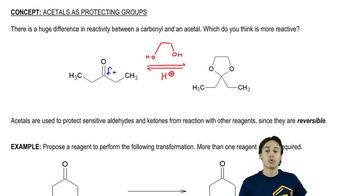
Protecting groups are temporary modifications used in organic synthesis to prevent certain functional groups from reacting during a chemical transformation. They allow chemists to selectively modify other parts of a molecule without interference. For example, in the conversion of alcohols, a protecting group can be added to the hydroxyl (-OH) group to shield it from reagents that would otherwise react with it.
Recommended video:
Guided course
02:44
Protecting Groups

Nucleophilic Substitution Reactions

Nucleophilic substitution reactions involve the replacement of a leaving group in a molecule with a nucleophile. In the context of converting 4-bromobutan-1-ol, the bromine atom serves as a leaving group, allowing a nucleophile to attack the carbon atom and form a new bond. Understanding the mechanisms of these reactions, such as SN1 and SN2 pathways, is crucial for predicting the outcome of the synthesis.
Recommended video:
Guided course
01:47
Nucleophiles and Electrophiles can react in Substitution Reactions.

Alkyne Formation

Alkyne formation typically involves the elimination of small molecules from a precursor compound, often through dehydrohalogenation or elimination reactions. In the synthesis of hept-5-yn-1-ol, the formation of the alkyne can be achieved by removing elements such as hydrogen halides from a suitable precursor. This step is essential for achieving the desired triple bond characteristic of alkynes.
Recommended video:
Guided course
09:11
Alkyne Hydration
Related Practice
Textbook Question

Show how you would accomplish the following transformations. Some of these examples require more than one step.

(a) 2-methylpropene → 2,2-dimethyloxirane

(b) 1-phenylethanol → 2-phenyloxirane

(c) 5-chloropent-1-ene → tetrahydropyran

1111
views
Textbook Question

Boron tribromide (BBr3) cleaves ethers to give alkyl halides and alcohols.

The reaction is thought to involve attack by a bromide ion on the Lewis acid–base adduct of the ether with BBr3 (a strong Lewis acid). Propose a mechanism for the reaction of butyl methyl ether with BBr3 to give (after hydrolysis) butan-1-ol and bromomethane.

1579
views
Textbook Question

Show how you would accomplish the following transformations. Some of these examples require more than one step.

(e) 2-chlorohexan-1-ol → 1,2-epoxyhexane

515
views
Textbook Question

Show how you would synthesize butyl isopropyl sulfide using butan-1-ol, propan-2-ol, and any solvents and reagents you need.

1108
views
Textbook Question

Show how you would accomplish the following transformations. Some of these examples require more than one step.

(d) 5-chloropent-1-ene → 2-methyltetrahydrofuran 

968
views
Textbook Question

Mustard gas, Cl–CH2CH2–S–CH2CH2–Cl, was used as a poisonous chemical agent in World War I. Mustard gas is much more toxic than a typical primary alkyl chloride. Its toxicity stems from its ability to alkylate amino groups on important metabolic enzymes, rendering the enzymes inactive.

a. Propose a mechanism to explain why mustard gas is an exceptionally potent alkylating agent.

b. Bleach (sodium hypochlorite, NaOCl, a strong oxidizing agent) neutralizes and inactivates mustard gas. Bleach is also effective on organic stains because it oxidizes colored compounds to colorless compounds. Propose products that might be formed by the reaction of mustard gas with bleach.

1173
views