Textbook Question
Sketch the pi molecular orbitals of hexa-1,3,5-triene.
2539
views

 Wade 9th EditionCh. 15 - Conjugated Systems, Orbital Symmetry, and Ultraviolet SpectroscopyProblem 35b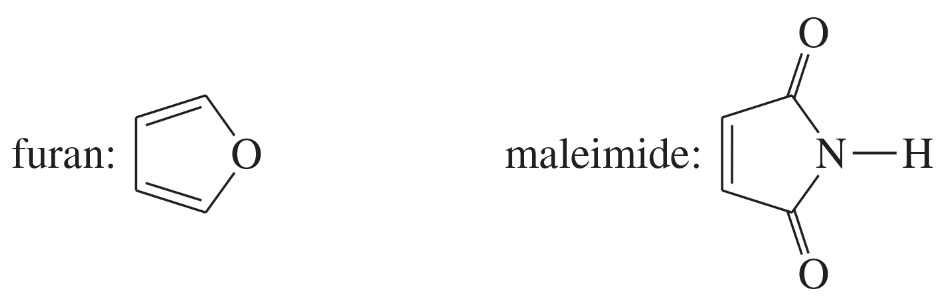
 Verified step by step guidance
 04:02
04:02
 01:10
01:10 06:47
06:47Sketch the pi molecular orbitals of hexa-1,3,5-triene.
Show the electronic configuration of the ground state of hexa-1,3,5-triene.
Furan and maleimide undergo a Diels–Alder reaction at 25 °C to give the endo isomer of the product. When the reaction takes place at 90 °C, however, the major product is the exo isomer. Further study shows that the endo isomer of the product isomerizes to the exo isomer at 90 °C.
a. Draw and label the endo and exo isomers of the Diels–Alder adduct of furan and maleimide.
Give the structures of the products represented by letters in this synthesis.
Part 1:
Furan and maleimide undergo a Diels–Alder reaction at 25 °C to give the endo isomer of the product. When the reaction takes place at 90 °C, however, the major product is the exo isomer. Further study shows that the endo isomer of the product isomerizes to the exo isomer at 90 °C.
c. Examine your answer to (b) and determine whether this answer applies to a reaction that is kinetically controlled or one that is thermodynamically controlled, or both.
Give the structures of the products represented by letters in this synthesis.
Part 2: