Ch. 15 - Conjugated Systems, Orbital Symmetry, and Ultraviolet Spectroscopy
Wade - Organic Chemistry 9th Edition
Wade9th EditionOrganic ChemistryISBN: 9780135213728Not the one you use?Change textbook
Chapter 15, Problem 34b

Give the structures of the products represented by letters in this synthesis.
Part 2:

Verified step by step guidance
1
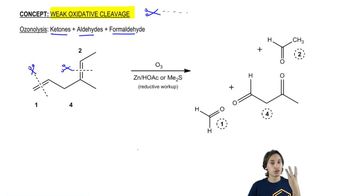
Step 1: Analyze the first reaction in Part 2, which involves ozonolysis of the alkyne using O₃ at -78°C followed by reduction with (CH₃)₂S. This cleaves the triple bond and forms two carbonyl compounds (aldehydes or ketones) depending on the structure of the alkyne.
Step 2: The resulting carbonyl compounds (F) are subjected to reduction using NaBH₄ in CH₃OH. Sodium borohydride reduces aldehydes and ketones to their corresponding alcohols.
Step 3: The alcohols formed in Step 2 are then treated with H₃O⁺ (acidic conditions), which may lead to protonation or further reaction depending on the functional groups present.
Step 4: The intermediate (G) is heated with H₂SO₄ under dehydrating conditions. Sulfuric acid promotes elimination reactions, leading to the formation of an α,β-unsaturated carbonyl compound or cyclic structure (H).
Step 5: The final product (H) is identified as C₃H₄O₂, which corresponds to a compound with three carbons, four hydrogens, and two oxygens. This suggests a carboxylic acid or ester structure formed through the sequence of reactions.

Verified video answer for a similar problem:

This video solution was recommended by our tutors as helpful for the problem above.
Video duration:
10m
Was this helpful?

Key Concepts

Here are the essential concepts you must grasp in order to answer the question correctly.

Ozonolysis

Ozonolysis is a reaction involving the cleavage of alkenes or alkynes using ozone (O3) to form carbonyl compounds. In this process, the alkene is treated with ozone at low temperatures, resulting in the formation of ozonides, which can be further hydrolyzed to yield aldehydes or ketones. Understanding this reaction is crucial for predicting the structures of products F and G in the synthesis.
Recommended video:
Guided course
06:30
General properties of ozonolysis.

Reduction Reactions

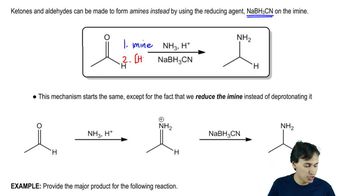
Reduction reactions involve the gain of electrons or hydrogen, or the loss of oxygen, resulting in a decrease in oxidation state. In this synthesis, sodium borohydride (NaBH4) is used as a reducing agent to convert carbonyl compounds into alcohols. Recognizing the role of reduction is essential for determining the structure of product G after the reaction with NaBH4.
Recommended video:
Guided course
07:12
Reductive Amination

Acid-Catalyzed Reactions

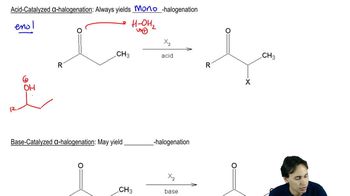
Acid-catalyzed reactions involve the use of an acid to facilitate the transformation of reactants into products, often by protonating a reactant to make it more reactive. In this synthesis, sulfuric acid (H2SO4) is used to promote the dehydration of alcohols to form alkenes or other products. Understanding this concept is key to predicting the final structure of product H in the reaction sequence.
Recommended video:
Guided course
03:09
Acid Catalyzed
Related Practice
Textbook Question

Give the structures of the products represented by letters in this synthesis.

Part 3:

1073
views

Textbook Question

Furan and maleimide undergo a Diels–Alder reaction at 25 °C to give the endo isomer of the product. When the reaction takes place at 90 °C, however, the major product is the exo isomer. Further study shows that the endo isomer of the product isomerizes to the exo isomer at 90 °C.

b. Which isomer of the product would you usually expect from this reaction? Explain why this isomer is usually favored.

1421
views
1
rank
Textbook Question

Furan and maleimide undergo a Diels–Alder reaction at 25 °C to give the endo isomer of the product. When the reaction takes place at 90 °C, however, the major product is the exo isomer. Further study shows that the endo isomer of the product isomerizes to the exo isomer at 90 °C.

a. Draw and label the endo and exo isomers of the Diels–Alder adduct of furan and maleimide.

897
views
Textbook Question

Give the structures of the products represented by letters in this synthesis.

Part 1:

1351
views
Textbook Question

Furan and maleimide undergo a Diels–Alder reaction at 25 °C to give the endo isomer of the product. When the reaction takes place at 90 °C, however, the major product is the exo isomer. Further study shows that the endo isomer of the product isomerizes to the exo isomer at 90 °C.

c. Examine your answer to (b) and determine whether this answer applies to a reaction that is kinetically controlled or one that is thermodynamically controlled, or both.

550
views
Textbook Question

Show how Diels–Alder reactions might be used to synthesize the following compounds.

(i)

685
views