Ch. 15 - Conjugated Systems, Orbital Symmetry, and Ultraviolet Spectroscopy
Wade - Organic Chemistry 9th Edition
Wade9th EditionOrganic ChemistryISBN: 9780135213728Not the one you use?Change textbook
Chapter 15, Problem 25b

Predict the products of the following reactions.
(b) cyclopentadiene + anhydrous HCl

Verified step by step guidance
1
Step 1: Recognize the type of reaction. Cyclopentadiene is a conjugated diene, and anhydrous HCl is a strong acid. This reaction involves electrophilic addition, where HCl adds across the double bonds of cyclopentadiene.
Step 2: Identify the electrophile and nucleophile. In HCl, the H⁺ ion acts as the electrophile, and the Cl⁻ ion acts as the nucleophile. Cyclopentadiene has two double bonds that can act as nucleophiles.
Step 3: Determine the regioselectivity of the addition. The proton (H⁺) will preferentially add to the carbon of the double bond that leads to the most stable carbocation intermediate. In cyclopentadiene, this typically results in the formation of a resonance-stabilized carbocation.
Step 4: Add the nucleophile (Cl⁻) to the carbocation. Once the carbocation is formed, the chloride ion (Cl⁻) will attack the positively charged carbon, completing the addition reaction.
Step 5: Predict the final product. The addition of HCl across one of the double bonds in cyclopentadiene will result in a chlorinated cyclopentene derivative. Consider stereochemistry and regioselectivity when predicting the structure of the product.

Verified video answer for a similar problem:

This video solution was recommended by our tutors as helpful for the problem above.
Video duration:
5m
Was this helpful?

Key Concepts

Here are the essential concepts you must grasp in order to answer the question correctly.

Electrophilic Addition

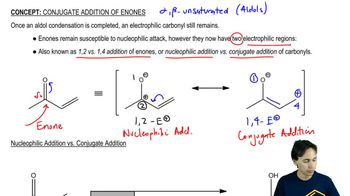
Electrophilic addition is a fundamental reaction mechanism in organic chemistry where an electrophile reacts with a nucleophile, resulting in the formation of a new bond. In the case of cyclopentadiene and anhydrous HCl, the double bonds in cyclopentadiene act as nucleophiles, attacking the electrophilic hydrogen in HCl, leading to the formation of a more stable product.
Recommended video:
Guided course
09:23
1,2 vs 1,4 Addition

Cyclopentadiene Structure

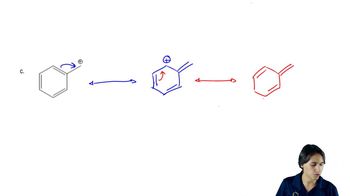
Cyclopentadiene is a cyclic diene with two conjugated double bonds. Its structure allows for unique reactivity patterns, particularly in electrophilic addition reactions. The presence of these double bonds makes cyclopentadiene highly reactive, enabling it to undergo various transformations, including the addition of HCl.
Recommended video:
Guided course
03:04
Drawing Resonance Structures

Markovnikov's Rule

Markovnikov's Rule states that in the addition of HX to an alkene, the hydrogen atom will attach to the carbon with the greater number of hydrogen atoms already attached. This principle helps predict the regioselectivity of the reaction products when cyclopentadiene reacts with HCl, guiding the formation of the more stable carbocation intermediate during the reaction.
Recommended video:
Guided course
03:54
The 18 and 16 Electron Rule