Ch. 15 - Conjugated Systems, Orbital Symmetry, and Ultraviolet Spectroscopy
Wade - Organic Chemistry 9th Edition
Wade9th EditionOrganic ChemistryISBN: 9780135213728Not the one you use?Change textbook
Chapter 15, Problem 25e

Predict the products of the following reactions.
(e) buta-1,3-diene + bromine water

Verified step by step guidance
1
Identify the type of reaction: The reaction involves buta-1,3-diene (a conjugated diene) and bromine water (Br₂ in water). This is an electrophilic addition reaction, where bromine reacts with the double bonds in the diene system.
Analyze the structure of buta-1,3-diene: Buta-1,3-diene has two conjugated double bonds. The conjugation allows for resonance stabilization, which will influence the regioselectivity and stereochemistry of the reaction.
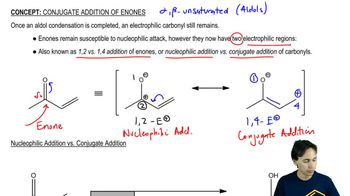
Determine the possible reaction pathways: Bromine can add to the diene in two ways: (1) 1,2-addition, where bromine adds across the first double bond, and (2) 1,4-addition, where bromine adds across the conjugated system, resulting in a product with a double bond shifted to the middle of the molecule.
Consider the reaction conditions: Bromine water is an aqueous solution, so the reaction may also involve the formation of bromohydrins (addition of Br and OH groups) due to the presence of water as a nucleophile. This can compete with the direct addition of bromine.
Draw the possible products: For 1,2-addition, the product will be 3,4-dibromobut-1-ene. For 1,4-addition, the product will be 1-bromo-2-buten-3-ol (if water participates) or 1,4-dibromobut-2-ene (if bromine adds directly). Ensure to account for stereochemistry in the products, as the addition of bromine can lead to anti-addition (trans products).

Verified video answer for a similar problem:

This video solution was recommended by our tutors as helpful for the problem above.
Video duration:
6m
Was this helpful?

Key Concepts

Here are the essential concepts you must grasp in order to answer the question correctly.

Diene Reactivity

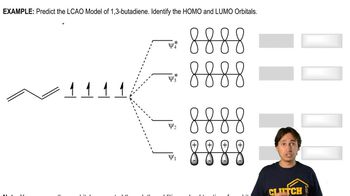
Butadiene is a conjugated diene, which means it has alternating double bonds. This structure allows for greater stability and reactivity in electrophilic addition reactions. Understanding how dienes react with electrophiles, such as bromine, is crucial for predicting the products of the reaction.
Recommended video:
Guided course
04:43
Drawing MO Diagram for Dienes

Electrophilic Addition

Electrophilic addition is a fundamental reaction mechanism in organic chemistry where an electrophile reacts with a nucleophile, resulting in the formation of a more saturated product. In the case of buta-1,3-diene and bromine, the bromine acts as an electrophile, adding across the double bonds of the diene.
Recommended video:
Guided course
09:23
1,2 vs 1,4 Addition

Regioselectivity

Regioselectivity refers to the preference of a chemical reaction to yield one structural isomer over others when multiple products are possible. In the reaction of buta-1,3-diene with bromine, the formation of different dibrominated products can occur, and understanding regioselectivity helps predict which product will be favored based on the stability of the intermediates formed during the reaction.
Recommended video:
Guided course
05:09
Heck Reaction