Ch. 15 - Conjugated Systems, Orbital Symmetry, and Ultraviolet Spectroscopy
Wade - Organic Chemistry 9th Edition
Wade9th EditionOrganic ChemistryISBN: 9780135213728Not the one you use?Change textbook
Chapter 15, Problem 33i

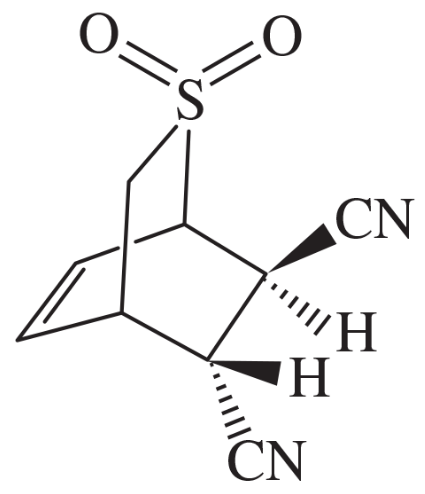
Show how Diels–Alder reactions might be used to synthesize the following compounds.
(i)

Verified step by step guidance
1
Step 1: Identify the target molecule as a bicyclic compound with a sulfone group and two cyano groups attached to the bridgehead carbons. This structure suggests that it could be synthesized using a Diels–Alder reaction followed by functional group modifications.
Step 2: Recognize that the Diels–Alder reaction involves a conjugated diene and a dienophile. The bicyclic structure indicates that the reaction likely involves a cyclic diene and a dienophile with electron-withdrawing groups to facilitate the reaction.
Step 3: Propose the diene as cyclopentadiene, which is commonly used in Diels–Alder reactions to form bicyclic systems. Cyclopentadiene has the necessary conjugated double bonds to act as the diene.
Step 4: Suggest the dienophile as a molecule containing electron-withdrawing groups such as cyano groups (–CN). A possible dienophile could be fumaronitrile (trans-1,2-dicyanoethene), which has two cyano groups that can stabilize the transition state during the reaction.
Step 5: After the Diels–Alder reaction forms the bicyclic intermediate, introduce the sulfone group (–SO2) through an oxidation reaction. This can be achieved by treating the intermediate with a sulfonylating agent such as sulfur dioxide (SO2) or a sulfonyl chloride under appropriate conditions.

Verified video answer for a similar problem:

This video solution was recommended by our tutors as helpful for the problem above.
Video duration:
7m
Was this helpful?

Key Concepts

Here are the essential concepts you must grasp in order to answer the question correctly.

Diels–Alder Reaction

The Diels–Alder reaction is a [4+2] cycloaddition reaction between a conjugated diene and a dienophile, resulting in the formation of a six-membered ring. This reaction is a powerful tool in organic synthesis due to its ability to create complex cyclic structures in a single step, often with high stereoselectivity and regioselectivity.
Recommended video:
Guided course
04:02
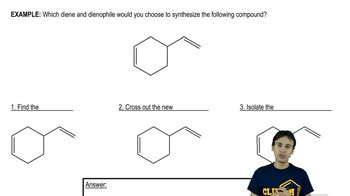
Diels-Alder Retrosynthesis

Conjugated Dienes

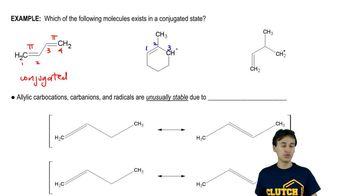
Conjugated dienes are compounds that contain two double bonds separated by a single bond, allowing for resonance stabilization. This property enhances their reactivity in Diels–Alder reactions, as the electron-rich diene can effectively interact with an electron-deficient dienophile, facilitating the cycloaddition process.
Recommended video:
Guided course
03:27
Conjugated states

Stereochemistry in Diels–Alder Reactions

Stereochemistry plays a crucial role in Diels–Alder reactions, as the orientation of substituents on the diene and dienophile can influence the final product's configuration. The reaction typically proceeds with a concerted mechanism, preserving the stereochemistry of the reactants, which is essential for predicting the structure of the synthesized compound.
Recommended video:
Guided course
04:02
Diels-Alder Retrosynthesis