Ch. 15 - Conjugated Systems, Orbital Symmetry, and Ultraviolet Spectroscopy
Wade - Organic Chemistry 9th Edition
Wade9th EditionOrganic ChemistryISBN: 9780135213728Not the one you use?Change textbook
Chapter 15, Problem 10

When N-bromosuccinimide is added to hex-1-ene in CCl4 and a sunlamp is shone on the mixture, three products result.
(a) Give the structures of these three products.
(b) Propose a mechanism that accounts for the formation of these three products

Verified step by step guidance
1
Understand the role of N-bromosuccinimide (NBS): NBS is a reagent commonly used for allylic bromination in the presence of light or a radical initiator. It selectively brominates the allylic position of alkenes.
Analyze the structure of hex-1-ene: Hex-1-ene is a six-carbon chain with a double bond between the first and second carbons. The allylic positions are the carbons adjacent to the double bond (C3 and C5).
Step (a): Identify the three products: (1) The major product is the allylic bromination product where bromine is added to the allylic position (C3 or C5). (2) A minor product results from bromination at the other allylic position. (3) A third product forms due to addition of bromine across the double bond, resulting in a dibromoalkane.
Step (b): Propose the mechanism: (1) Initiation: Light (hv) generates bromine radicals (Br•) from NBS. (2) Propagation: A bromine radical abstracts an allylic hydrogen from hex-1-ene, forming an allylic radical. (3) The allylic radical reacts with Br2 (generated from NBS) to form the allylic bromination product. (4) Competing reaction: Bromine radicals can also add across the double bond, leading to the dibromoalkane.
Conclude the mechanism: The formation of the three products is explained by the selectivity of NBS for allylic bromination and the competing addition reaction across the double bond. The major product is the allylic bromination product, while the other two products are minor due to competing pathways.

Verified video answer for a similar problem:

This video solution was recommended by our tutors as helpful for the problem above.
Video duration:
15m
Was this helpful?

Key Concepts

Here are the essential concepts you must grasp in order to answer the question correctly.

Electrophilic Addition

Electrophilic addition is a fundamental reaction mechanism in organic chemistry where an electrophile reacts with a nucleophile, typically involving alkenes. In this case, hex-1-ene acts as a nucleophile, reacting with N-bromosuccinimide, which serves as the electrophile. This process leads to the formation of more stable products through the addition of bromine across the double bond.
Recommended video:
Guided course
09:23
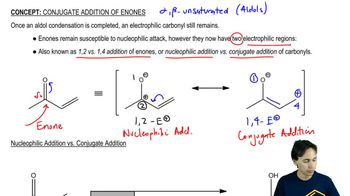
1,2 vs 1,4 Addition

Radical Mechanism

A radical mechanism involves the formation of free radicals, which are highly reactive species with unpaired electrons. In the presence of light, such as from a sunlamp, N-bromosuccinimide can undergo homolytic cleavage to generate bromine radicals. These radicals can then add to the alkene, leading to the formation of various products through radical intermediates.
Recommended video:
Guided course
03:28
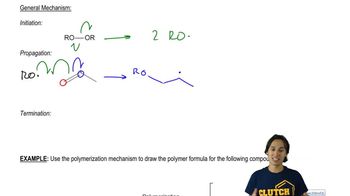
The mechanism of Radical Polymerization.

Product Distribution

Product distribution refers to the different products formed in a chemical reaction and their relative amounts. In the reaction of hex-1-ene with N-bromosuccinimide, the conditions (like light and solvent) can influence which products are favored. Understanding the stability of intermediates and the pathways available helps predict the distribution of the three products formed in this reaction.
Recommended video:
Guided course
11:07
Bridged-Products
Related Practice
Textbook Question

Show how you might synthesize the following compounds starting with bromobenzene, and alkyl or alkenyl halides of four carbon atoms or fewer.

a. 3-phenylprop-1-ene

1164
views

Textbook Question

Propose a mechanism for each reaction, showing explicitly how the observed mixtures of products are formed.

(e) 3-chlorobut-1-ene + AgNO3, H2O → but-2-en-1-ol + but-3-en-2-ol

892
views
Textbook Question

When Br2 is added to buta-1,3-diene at –15 °C, the product mixture contains 60% of product A and 40% of product B. When the same reaction takes place at 60 °C, the product ratio is 10% A and 90% B.

a. Propose structures for products A and B. (Hint: In many cases, an allylic carbocation is more stable than a bromonium ion.)

b. Propose a mechanism to account for formation of both A and B.

c. Show why A predominates at –15 °C and B predominates at 60 °C.

1058
views
Textbook Question

When Br2 is added to buta-1,3-diene at –15 °C, the product mixture contains 60% of product A and 40% of product B. When the same reaction takes place at 60 °C, the product ratio is 10% A and 90% B.

d. If you had a solution of pure A, and its temperature were raised to 60 °C, what would you expect to happen? Propose a mechanism to support your prediction.

758
views
Textbook Question

Show how you might synthesize the following compounds starting with bromobenzene, and alkyl or alkenyl halides of four carbon atoms or fewer.

b. 5-methylhex-2-ene

1034
views
Textbook Question

Addition of 1-bromobut-2-ene to magnesium metal in dry ether results in formation of a Grignard reagent. Addition of water to this Grignard reagent gives a mixture of but-1-ene and but-2-ene (cis and trans). When the Grignard reagent is made using 3-bromobut-1-ene, addition of water produces exactly the same mixture of products in the same ratios. Explain this curious result

1009
views