Ch. 15 - Conjugated Systems, Orbital Symmetry, and Ultraviolet Spectroscopy
Wade - Organic Chemistry 9th Edition
Wade9th EditionOrganic ChemistryISBN: 9780135213728Not the one you use?Change textbook
Chapter 15, Problem 8d

When Br2 is added to buta-1,3-diene at –15 °C, the product mixture contains 60% of product A and 40% of product B. When the same reaction takes place at 60 °C, the product ratio is 10% A and 90% B.
d. If you had a solution of pure A, and its temperature were raised to 60 °C, what would you expect to happen? Propose a mechanism to support your prediction.

Verified step by step guidance
1
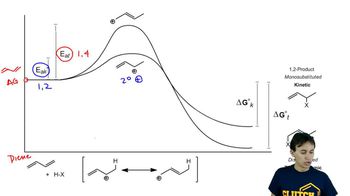
Step 1: Understand the context of the problem. The reaction involves the addition of Br₂ to buta-1,3-diene, which can proceed via two pathways: 1,2-addition and 1,4-addition. The product distribution depends on the reaction temperature, with product A (major at -15 °C) likely being the kinetic product and product B (major at 60 °C) being the thermodynamic product.
Step 2: Analyze the behavior of the products. At higher temperatures, the thermodynamic product (B) becomes more favorable due to its greater stability. This suggests that product A can convert to product B under thermodynamic control if sufficient energy is provided.
Step 3: Propose a mechanism for the interconversion. Product A (1,2-addition product) can revert to the carbocation intermediate under elevated temperatures. This intermediate can then rearrange and lead to the formation of product B (1,4-addition product), which is more stable due to conjugation and lower overall energy.
Step 4: Predict the outcome. If a solution of pure A is heated to 60 °C, it is expected that some of A will convert to B over time, as the system moves toward thermodynamic equilibrium. The extent of conversion will depend on the reaction conditions and the energy barrier for the reverse reaction.
Step 5: Summarize the reasoning. The conversion of A to B at higher temperatures is supported by the principle of thermodynamic control, where the more stable product (B) predominates. The mechanism involves the reversible formation of a carbocation intermediate, allowing the system to equilibrate and favor the thermodynamic product.

Verified video answer for a similar problem:

This video solution was recommended by our tutors as helpful for the problem above.
Video duration:
4m
Was this helpful?

Key Concepts

Here are the essential concepts you must grasp in order to answer the question correctly.

Electrophilic Addition Reactions

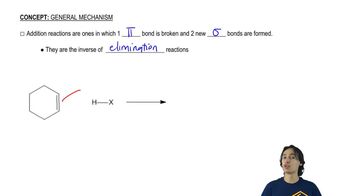
Electrophilic addition reactions involve the addition of an electrophile to a nucleophile, typically seen in alkenes and conjugated systems. In the case of buta-1,3-diene reacting with Br2, the double bonds act as nucleophiles, attacking the electrophilic bromine molecule. This reaction can lead to different products depending on the conditions, such as temperature, which influences the stability of intermediates and the final product distribution.
Recommended video:
Guided course
05:39
Features of Addition Mechanisms.

Temperature Effects on Reaction Mechanisms

Temperature significantly affects reaction mechanisms and product distribution. At lower temperatures, reactions may favor the formation of more stable intermediates, leading to a higher yield of one product over another. Conversely, at higher temperatures, the increased kinetic energy can promote the formation of less stable intermediates, resulting in a different product ratio, as seen in the change from 60% A and 40% B at -15 °C to 10% A and 90% B at 60 °C.
Recommended video:
3:26
Directing Effects in Substituted Pyrroles, Furans, and Thiophenes Concept 2

Kinetics vs. Thermodynamics

The distinction between kinetics and thermodynamics is crucial in understanding reaction outcomes. Kinetics refers to the rate of a reaction and the pathway taken, while thermodynamics relates to the stability of products and their favorability. In the context of the question, the product A may be kinetically favored at lower temperatures, while product B becomes thermodynamically favored at higher temperatures, leading to a shift in product ratios when the temperature is increased.
Recommended video:
Guided course
08:51
Kinetic vs. Thermodynamic Control
Related Practice
Textbook Question

Show how you might synthesize the following compounds starting with bromobenzene, and alkyl or alkenyl halides of four carbon atoms or fewer.

a. 3-phenylprop-1-ene

1164
views

Textbook Question

Propose a mechanism for each reaction, showing explicitly how the observed mixtures of products are formed.

(e) 3-chlorobut-1-ene + AgNO3, H2O → but-2-en-1-ol + but-3-en-2-ol

892
views
Textbook Question

Propose a mechanism for each reaction, showing explicitly how the observed mixtures of products are formed.

c. cyclopenta-1,3-diene + Br2 → 3,4-dibromocyclopent-1-ene + 3,5-dibromocyclopent-1-ene

577
views
Textbook Question

When Br2 is added to buta-1,3-diene at –15 °C, the product mixture contains 60% of product A and 40% of product B. When the same reaction takes place at 60 °C, the product ratio is 10% A and 90% B.

a. Propose structures for products A and B. (Hint: In many cases, an allylic carbocation is more stable than a bromonium ion.)

b. Propose a mechanism to account for formation of both A and B.

c. Show why A predominates at –15 °C and B predominates at 60 °C.

1058
views
Textbook Question

When N-bromosuccinimide is added to hex-1-ene in CCl4 and a sunlamp is shone on the mixture, three products result.

(a) Give the structures of these three products.

(b) Propose a mechanism that accounts for the formation of these three products

2135
views
Textbook Question

Addition of 1-bromobut-2-ene to magnesium metal in dry ether results in formation of a Grignard reagent. Addition of water to this Grignard reagent gives a mixture of but-1-ene and but-2-ene (cis and trans). When the Grignard reagent is made using 3-bromobut-1-ene, addition of water produces exactly the same mixture of products in the same ratios. Explain this curious result

1009
views