
Ch. 16 - Aromatic Compounds
Wade - Organic Chemistry 9th Edition
Wade9th EditionOrganic ChemistryISBN: 9780135213728Not the one you use?Change textbook
Chapter 16, Problem 41

Anions of hydrocarbons are rare, and dianions of hydrocarbons are extremely rare. The following hydrocarbon reacts with two equivalents of butyllithium to form a dianion of formula [C8H6]2–. Propose a structure for this dianion, and suggest why it forms so readily.
Chemical reaction showing a hydrocarbon reacting with butyllithium to form a dianion and butane byproducts.

Verified step by step guidance
1
Step 1: Analyze the structure of the hydrocarbon provided in the image. The molecule is bicyclo[2.2.1]hepta-2,5-diene, commonly known as norbornadiene. It contains two double bonds in conjugation within a strained bicyclic system.
Step 2: Understand the reaction with butyllithium. Butyllithium (C4H9Li) is a strong base and nucleophile. It can abstract acidic protons from the hydrocarbon, leading to the formation of an anion. In this case, two equivalents of butyllithium are used, suggesting the removal of two protons to form a dianion.
Step 3: Identify the acidic protons in norbornadiene. The protons adjacent to the double bonds (allylic positions) are relatively acidic due to the stabilization of the resulting anion by resonance. Removing these protons leads to the formation of a conjugated dianion.
Step 4: Propose the structure of the dianion [C8H6]2-. The removal of two protons from the allylic positions results in a dianion where the negative charges are delocalized over the conjugated π-system. This delocalization stabilizes the dianion, making its formation favorable.
Step 5: Explain why the dianion forms readily. The strained bicyclic structure of norbornadiene increases the acidity of the allylic protons, and the resulting dianion is stabilized by resonance. Additionally, the use of butyllithium ensures efficient deprotonation due to its strong basicity.

Verified video answer for a similar problem:

This video solution was recommended by our tutors as helpful for the problem above.
Video duration:
5m
Was this helpful?

Key Concepts

Here are the essential concepts you must grasp in order to answer the question correctly.

Dianions

Dianions are negatively charged species that contain two extra electrons, resulting in a -2 charge. They are typically formed from compounds that can stabilize the negative charge through resonance or inductive effects. In hydrocarbons, the formation of dianions is rare due to the instability of the negative charges; however, certain structures, like conjugated systems, can accommodate these charges more effectively.
Recommended video:
Guided course
01:14
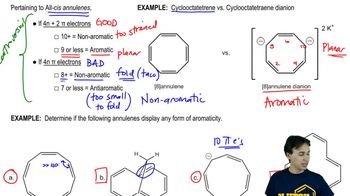
Determine annulene aromaticity

Butyllithium

Butyllithium is a strong organolithium reagent commonly used in organic synthesis to deprotonate compounds and generate carbanions. It is highly reactive and can abstract protons from hydrocarbons, facilitating the formation of anions. The use of two equivalents of butyllithium in the reaction suggests that it is necessary to fully deprotonate the hydrocarbon to achieve the dianion state.
Recommended video:
1:12
Anionic Polymerization Concept 2

Stabilization of Anions

The stability of anions, including dianions, is influenced by the ability of the surrounding molecular structure to delocalize the negative charge. Factors such as resonance, electronegativity of adjacent atoms, and hybridization play crucial roles in this stabilization. In the case of the proposed dianion, the presence of conjugated double bonds or electron-withdrawing groups can significantly enhance the stability of the negative charges, making the formation of the dianion more favorable.
Recommended video:
0:53
Anionic Polymerization Concept 3
Related Practice
Textbook Question

Biphenyl has the following structure.

c. The heat of hydrogenation for biphenyl is about 418 kJ/mol (100 kcal/mol). Calculate the resonance energy of biphenyl.

d. Compare the resonance energy of biphenyl with that of naphthalene and with that of two benzene rings. Explain the difference in the resonance energies of naphthalene and biphenyl.

1276
views
Textbook Question

Biphenyl has the following structure.

a. Is biphenyl a (fused) polynuclear aromatic hydrocarbon?

b. How many pi electrons are there in the two aromatic rings of biphenyl? How does this number compare with that for naphthalene?

1440
views
Textbook Question

The ribonucleosides that make up ribonucleic acid (RNA) are composed of D-ribose (a sugar) and four heterocyclic “bases.” The general structure of a ribonucleoside is shown here.

The four heterocyclic bases are cytosine, uracil, guanine, and adenine. Cytosine and uracil are called pyrimidine bases because their structures resemble pyrimidine. Guanine and adenine are called purine bases because their structures resemble purine.

a. Determine which rings of these bases are aromatic.

914
views
Textbook Question

How would you convert the following compounds to aromatic compounds?

(d)

(e)

(f)

1773
views
1
rank
Textbook Question

Recall (Section 16-10) that two positions of anthracene sometimes react more like polyenes than like aromatic compounds.

b. The Diels–Alder reaction of anthracene with maleic anhydride is a common organic lab experiment. Predict the product of this Diels–Alder reaction.

766
views
Textbook Question

How would you convert the following compounds to aromatic compounds?

(a)

(b)

(c)

1138
views