Ch. 16 - Aromatic Compounds
Wade - Organic Chemistry 9th Edition
Wade9th EditionOrganic ChemistryISBN: 9780135213728Not the one you use?Change textbook
Chapter 16, Problem 22a

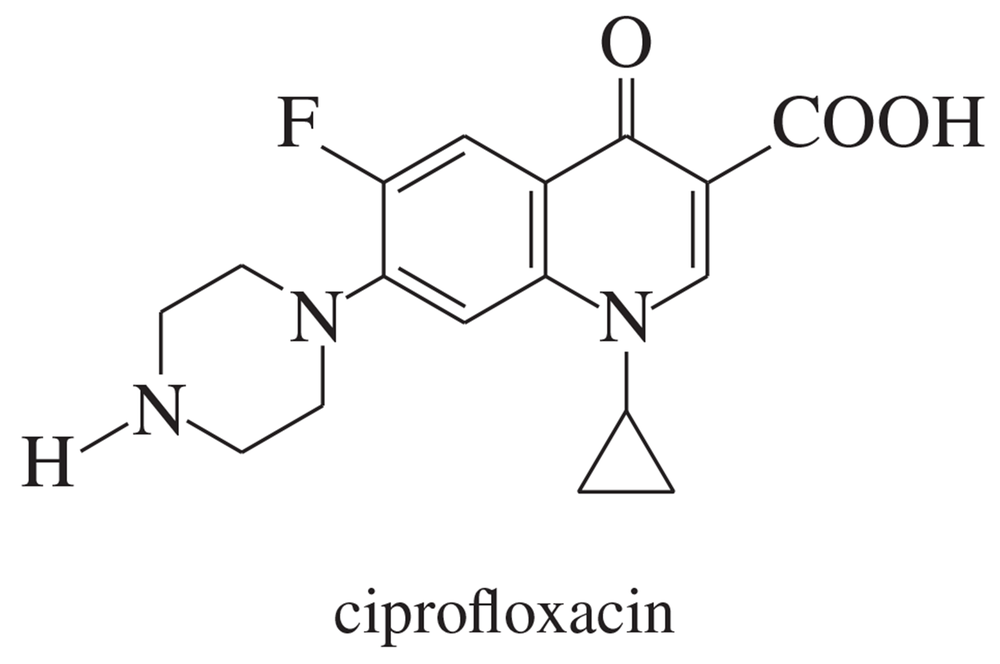
Ciprofloxacin is a member of the fluoroquinolone class of antibiotics.

a. Which of its rings are aromatic?

Verified step by step guidance
1
Step 1: Recall the criteria for aromaticity. A compound is aromatic if it satisfies the following conditions: (1) It is cyclic, (2) It is planar, (3) It has a conjugated π-electron system, and (4) It follows Hückel's rule, which states that the molecule must have (4n + 2) π-electrons, where n is a non-negative integer.
Step 2: Examine the structure of ciprofloxacin. Identify the rings present in the molecule and determine if they are cyclic and planar. Aromatic rings are typically flat due to conjugation.
Step 3: Check for conjugation in each ring. Conjugation occurs when π-electrons are delocalized across alternating single and double bonds or lone pairs. Look for alternating double bonds or lone pairs that contribute to the π-electron system.
Step 4: Apply Hückel's rule to each ring. Count the number of π-electrons in the conjugated system of each ring and verify if the number satisfies the (4n + 2) rule. For example, a ring with 6 π-electrons (n = 1) is aromatic.
Step 5: Based on the analysis, identify which rings in ciprofloxacin meet all the criteria for aromaticity. Note that aromaticity is a property of individual rings, so each ring must be evaluated separately.

Verified video answer for a similar problem:

This video solution was recommended by our tutors as helpful for the problem above.
Video duration:
7m
Was this helpful?

Key Concepts

Here are the essential concepts you must grasp in order to answer the question correctly.

Aromaticity

Aromaticity refers to a property of cyclic compounds that exhibit enhanced stability due to the delocalization of π-electrons across the ring structure. For a compound to be considered aromatic, it must follow Hückel's rule, which states that it should have a planar structure and contain a specific number of π-electrons (4n + 2, where n is a non-negative integer). This concept is crucial for identifying which rings in ciprofloxacin are aromatic.
Recommended video:
Guided course
08:19
Intro to Aromaticity

Fluoroquinolones

Fluoroquinolones are a class of synthetic antibiotics characterized by their broad-spectrum activity against bacteria. They contain a fluorine atom, which enhances their antibacterial potency and pharmacokinetic properties. Understanding the structure of fluoroquinolones, including ciprofloxacin, is essential for analyzing their chemical properties, including the presence of aromatic rings.

Chemical Structure of Ciprofloxacin

Ciprofloxacin has a complex chemical structure that includes multiple rings, some of which may be aromatic. Analyzing its molecular structure involves identifying the different functional groups and ring systems present. Recognizing the specific rings and their bonding characteristics is key to determining which of them exhibit aromaticity.
Recommended video:
3:11
Chemical Reactions of Phosphate Anhydrides Concept 1