Ch. 16 - Aromatic Compounds
Wade - Organic Chemistry 9th Edition
Wade9th EditionOrganic ChemistryISBN: 9780135213728Not the one you use?Change textbook
Chapter 16, Problem 22b

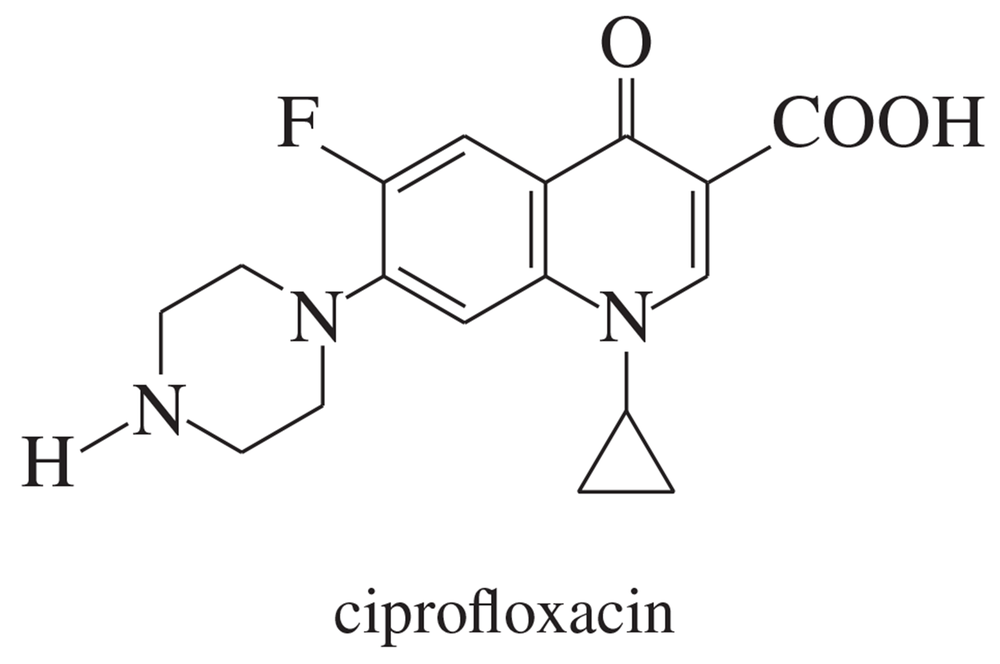
Ciprofloxacin is a member of the fluoroquinolone class of antibiotics.

(b) Which nitrogen atoms are basic?

Verified step by step guidance
1
Identify the structure of ciprofloxacin, which contains multiple nitrogen atoms in its molecular framework. These nitrogen atoms can be part of aromatic rings, amines, or other functional groups.
Recall the concept of basicity in organic chemistry: a nitrogen atom is considered basic if it has a lone pair of electrons that can accept a proton (H⁺). The availability of this lone pair is influenced by the electronic environment around the nitrogen.
Examine each nitrogen atom in the structure of ciprofloxacin. Determine whether the lone pair on each nitrogen is delocalized (shared in resonance) or localized. If the lone pair is delocalized, the nitrogen is less basic because the lone pair is not readily available for protonation.
Pay special attention to nitrogen atoms in aromatic systems (e.g., pyridine-like or pyrrole-like rings). In pyridine-like systems, the lone pair is not involved in aromaticity and is available for protonation, making the nitrogen basic. In pyrrole-like systems, the lone pair is part of the aromatic system and is not available for protonation, making the nitrogen non-basic.
Conclude which nitrogen atoms in ciprofloxacin are basic by identifying those with localized lone pairs that are not involved in resonance or aromaticity. These are the nitrogen atoms capable of accepting a proton.

Verified video answer for a similar problem:

This video solution was recommended by our tutors as helpful for the problem above.
Video duration:
3m
Was this helpful?

Key Concepts

Here are the essential concepts you must grasp in order to answer the question correctly.

Basicity in Organic Chemistry

Basicity refers to the ability of a compound to accept protons (H+) or donate electron pairs. In organic chemistry, basicity is often associated with the presence of lone pairs of electrons on nitrogen or other heteroatoms, which can interact with protons. Understanding the basicity of nitrogen atoms in a molecule is crucial for predicting its reactivity and interactions.
Recommended video:
Guided course
00:56
What is an organic molecule?

Structure of Ciprofloxacin

Ciprofloxacin is a fluoroquinolone antibiotic characterized by its bicyclic structure, which includes a piperazine ring containing nitrogen atoms. The arrangement of these nitrogen atoms and their hybridization states influence their basicity. Analyzing the molecular structure helps identify which nitrogen atoms can act as bases in chemical reactions.
Recommended video:
Guided course
03:04
Drawing Resonance Structures

Hybridization and Basicity

Hybridization describes the mixing of atomic orbitals to form new hybrid orbitals, which can affect the electron density and reactivity of atoms in a molecule. In ciprofloxacin, nitrogen atoms can be sp3 or sp2 hybridized, influencing their ability to donate electron pairs. Recognizing the hybridization state is essential for determining which nitrogen atoms are basic.
Recommended video:
Guided course
10:43
Using bond sites to predict hybridization