Ch. 16 - Aromatic Compounds
Wade - Organic Chemistry 9th Edition
Wade9th EditionOrganic ChemistryISBN: 9780135213728Not the one you use?Change textbook
Chapter 16, Problem 29a,b

Four pairs of compounds are shown. In each pair, one of the compounds reacts more quickly, or with a more favorable equilibrium constant, than the less conjugated system. In each case, explain the enhanced reactivity.
(a) Chemical structures comparing the basicity of two aromatic compounds, with text indicating one is more basic than the other.
(b) Two pairs of aromatic compounds are shown, highlighting differences in ionization rates and reactivity.

Verified step by step guidance
1
Step 1: Analyze the conjugation in the first pair of compounds. The compound on the left has a conjugated system due to the presence of alternating double bonds in the ring, which allows for delocalization of electrons. This delocalization increases the stability of the compound and enhances its basicity compared to the non-conjugated compound on the right.
Step 2: Consider the resonance effects in the first pair. The conjugated system on the left can stabilize the negative charge formed when the compound acts as a base, making it more favorable for the compound to accept a proton. The compound on the right lacks this resonance stabilization, making it less basic.
Step 3: For the second pair of compounds, examine the ionization process. The compound on the left has a conjugated system that allows for resonance stabilization of the positive charge formed after ionization. This stabilization makes ionization more favorable compared to the non-conjugated compound on the right.
Step 4: Evaluate the role of the chlorine atom in the second pair. The chlorine atom is an electron-withdrawing group, which can stabilize the positive charge formed during ionization. In the conjugated system on the left, the electron-withdrawing effect of chlorine is complemented by resonance stabilization, further enhancing ionization.
Step 5: Summarize the enhanced reactivity. In both pairs, the conjugated systems exhibit increased reactivity due to resonance stabilization, which either enhances basicity (first pair) or facilitates ionization (second pair). The lack of conjugation in the non-conjugated systems reduces their reactivity.

Verified video answer for a similar problem:

This video solution was recommended by our tutors as helpful for the problem above.
Video duration:
9m
Was this helpful?

Key Concepts

Here are the essential concepts you must grasp in order to answer the question correctly.

Conjugation

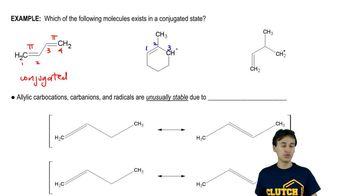
Conjugation refers to the overlap of p-orbitals across adjacent double bonds or lone pairs, allowing for delocalization of electrons. This delocalization stabilizes the molecule and can enhance its reactivity by lowering the energy barrier for reactions. In organic compounds, conjugated systems often exhibit increased stability and reactivity compared to their non-conjugated counterparts.
Recommended video:
Guided course
03:27
Conjugated states

Resonance

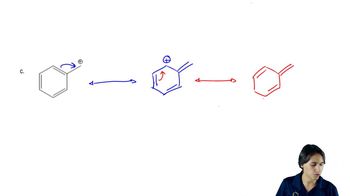
Resonance is a concept in organic chemistry where a molecule can be represented by two or more valid Lewis structures, known as resonance structures. The actual structure is a hybrid of these forms, leading to increased stability and reactivity. Compounds with significant resonance stabilization often react more readily due to the distribution of electron density across the molecule.
Recommended video:
Guided course
03:04
Drawing Resonance Structures

Equilibrium Constant

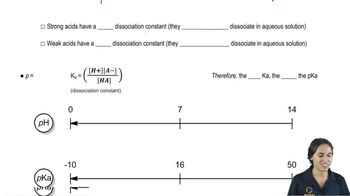
The equilibrium constant (K) is a numerical value that expresses the ratio of the concentrations of products to reactants at equilibrium for a given reaction. A larger K indicates a more favorable reaction, meaning products are favored over reactants. Understanding how structural features, such as conjugation and resonance, influence K is crucial for predicting the reactivity of different compounds.
Recommended video:
Guided course
02:19
The relationship between equilibrium constant and pKa.