Ch. 16 - Aromatic Compounds
Wade - Organic Chemistry 9th Edition
Wade9th EditionOrganic ChemistryISBN: 9780135213728Not the one you use?Change textbook
Chapter 16, Problem 29c

Four pairs of compounds are shown. In each pair, one of the compounds reacts more quickly, or with a more favorable equilibrium constant, than the less conjugated system. In each case, explain the enhanced reactivity.
(c) Chemical structures comparing dehydration reactivity of two compounds with hydroxyl groups.

Verified step by step guidance
1
Step 1: Analyze the structures of the two compounds. The first compound is benzyl alcohol, which contains a hydroxyl group (-OH) attached to a benzene ring. The second compound is cyclohexanol, which contains a hydroxyl group attached to a cyclohexane ring.
Step 2: Understand the dehydration reaction. Dehydration involves the removal of a water molecule, typically under acidic conditions, to form an alkene. In this case, benzyl alcohol will form a conjugated alkene (styrene), while cyclohexanol will form cyclohexene.
Step 3: Consider the stability of the carbocation intermediate. During dehydration, the hydroxyl group is protonated and leaves as water, forming a carbocation intermediate. The benzyl carbocation formed from benzyl alcohol is stabilized by resonance with the benzene ring, making it much more stable than the cyclohexyl carbocation formed from cyclohexanol, which lacks resonance stabilization.
Step 4: Evaluate the role of conjugation. The product of benzyl alcohol dehydration (styrene) is conjugated, meaning the double bond is in resonance with the benzene ring. This conjugation further stabilizes the product, making the reaction more favorable compared to the non-conjugated cyclohexene product formed from cyclohexanol.
Step 5: Conclude the enhanced reactivity. Benzyl alcohol dehydrates more easily than cyclohexanol due to the resonance stabilization of the benzyl carbocation intermediate and the conjugation in the final product, which lowers the activation energy and increases the equilibrium constant for the reaction.

Verified video answer for a similar problem:

This video solution was recommended by our tutors as helpful for the problem above.
Video duration:
4m
Was this helpful?

Key Concepts

Here are the essential concepts you must grasp in order to answer the question correctly.

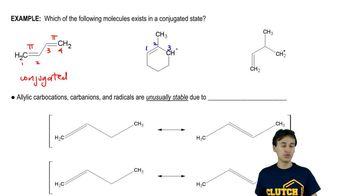
Conjugation

Conjugation refers to the overlap of p-orbitals across adjacent double bonds or lone pairs, allowing for delocalization of electrons. This delocalization stabilizes the molecule, making it more reactive in certain reactions, such as dehydration. In the context of the compounds shown, the more conjugated system can facilitate the loss of water more readily due to this stabilization.
Recommended video:
Guided course
03:27
Conjugated states

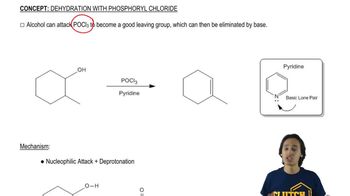
Dehydration Reaction

A dehydration reaction involves the removal of a water molecule from a compound, often resulting in the formation of a double bond. This reaction is crucial in organic chemistry for synthesizing alkenes from alcohols. The ease of dehydration can be influenced by the structure of the alcohol, where steric hindrance and electronic effects play significant roles in determining the reaction rate.
Recommended video:
Guided course
01:23
General Reaction of Dehydration with POCl3

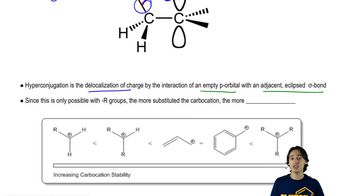
Stability of Carbocation Intermediates

During dehydration, a carbocation intermediate may form, and its stability is critical for the reaction's rate. More stable carbocations, such as tertiary or resonance-stabilized carbocations, will form more readily and lead to faster reactions. In the compounds presented, the one that dehydrates more easily likely forms a more stable carbocation, enhancing its reactivity compared to the less conjugated system.
Recommended video:
Guided course
05:58
Determining Carbocation Stability