Ch. 17 - Reactions of Aromatic Compounds
Wade - Organic Chemistry 9th Edition
Wade9th EditionOrganic ChemistryISBN: 9780135213728Not the one you use?Change textbook
Chapter 17, Problem 56

A student added 3-phenylpropanoic acid (PhCH2CH2COOH) to a molten salt consisting of a 1:1 mixture of NaCl and AlCl3 maintained at 170 °C. After 5 minutes, he poured the molten mixture into water and extracted it into dichloromethane. Evaporation of the dichloromethane gave a 96% yield of the product whose spectra follow. The mass spectrum of the product shows a molecular ion at m/z 132. What is the product?
<IMAGE>

Verified step by step guidance
1
Step 1: Analyze the starting material, 3-phenylpropanoic acid (PhCH2CH2COOH). It contains a benzene ring (Ph), a two-carbon chain (CH2CH2), and a carboxylic acid group (COOH).
Step 2: Recognize the reaction conditions. The molten salt mixture of NaCl and AlCl3 is a Lewis acidic medium, which can facilitate electrophilic aromatic substitution or other reactions involving the benzene ring.
Step 3: Consider the molecular ion peak at m/z 132 in the mass spectrum. This indicates the molecular weight of the product is 132 g/mol. Compare this to the molecular weight of the starting material (PhCH2CH2COOH), which is 150 g/mol. The decrease in molecular weight suggests the loss of a small group, likely CO2 (44 g/mol), indicating decarboxylation.
Step 4: Propose the decarboxylation mechanism. Under the reaction conditions, the carboxylic acid group (-COOH) can be removed as CO2, leaving behind a benzyl group (PhCH2CH2 → PhCH2). This is a common reaction for carboxylic acids in the presence of Lewis acids at elevated temperatures.
Step 5: Conclude that the product is toluene (PhCH3), which has a molecular weight of 132 g/mol. This matches the mass spectrum data and is consistent with the reaction conditions and the observed yield.

Verified video answer for a similar problem:

This video solution was recommended by our tutors as helpful for the problem above.
Video duration:
6m
Was this helpful?

Key Concepts

Here are the essential concepts you must grasp in order to answer the question correctly.

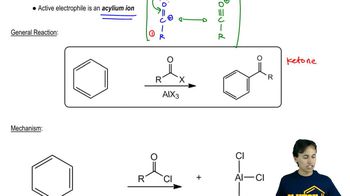
Friedel-Crafts Acylation

Friedel-Crafts acylation is a key reaction in organic chemistry where an acyl group is introduced into an aromatic ring using an acyl chloride and a Lewis acid catalyst, such as AlCl3. In this case, the 3-phenylpropanoic acid can undergo acylation to form a ketone, which is a common product of this reaction. Understanding this mechanism is crucial for predicting the product formed when the acid is treated with the molten salt mixture.
Recommended video:
Guided course
05:20
Friedel-Crafts Acylation

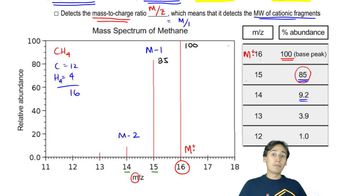
Mass Spectrometry

Mass spectrometry is an analytical technique used to measure the mass-to-charge ratio of ions. It provides information about the molecular weight of compounds, which helps in identifying the structure of the product. The molecular ion peak at m/z 132 indicates the molecular weight of the product, guiding the identification of the compound formed from the reaction of 3-phenylpropanoic acid.
Recommended video:
Guided course
01:25
How to Read a Mass Spectrum

Solubility and Extraction Techniques

Solubility and extraction techniques are essential for isolating products from reaction mixtures. In this scenario, the use of dichloromethane as a solvent allows for the selective extraction of organic compounds from the aqueous phase after the reaction. Understanding the principles of solubility and the partitioning of compounds between different phases is vital for successfully isolating and purifying the desired product.
Recommended video:
Guided course
05:41
Reason for Analytical Methods