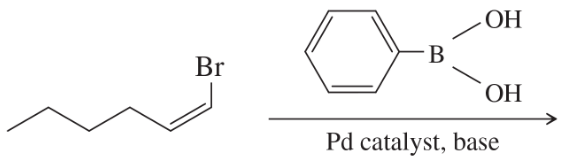
Give the structures of compounds A through B in the following series of reactions.
Ch. 17 - Reactions of Aromatic Compounds
Chapter 17, Problem 55c
What products would you expect from the following coupling reactions?
(c) 
Verified step by step guidance1
Step 1: Recognize the reaction type. This is a Suzuki coupling reaction, which involves the reaction of an organoboron compound (here, a phenylboronic acid derivative) with an organohalide (here, an allyl bromide) in the presence of a palladium catalyst and a base.
Step 2: Identify the components. The phenylboronic acid derivative provides the aryl group, while the allyl bromide provides the allyl group. The palladium catalyst facilitates the formation of a new carbon-carbon bond between these two groups.
Step 3: Understand the mechanism. The reaction proceeds through oxidative addition of the allyl bromide to the palladium catalyst, transmetalation with the phenylboronic acid derivative, and reductive elimination to form the coupled product.
Step 4: Predict the product. The new bond forms between the carbon atom of the phenyl group (from the boronic acid) and the carbon atom of the allyl group (from the allyl bromide). The product will be an aryl-allyl compound.
Step 5: Verify the structure. The final product will have the phenyl group directly bonded to the allyl group, maintaining the double bond in the allyl group and the methyl substituent on the allyl chain.

Verified video answer for a similar problem:
This video solution was recommended by our tutors as helpful for the problem above.
Video duration:
4mWas this helpful?
Key Concepts
Here are the essential concepts you must grasp in order to answer the question correctly.
Suzuki Coupling Reaction
The Suzuki coupling reaction is a widely used method in organic chemistry for forming carbon-carbon bonds. It involves the reaction of a boronic acid with an organic halide in the presence of a palladium catalyst and a base. This reaction is particularly valuable for synthesizing biaryl compounds and other complex organic molecules.
Palladium Catalysis
Palladium catalysis is crucial in many cross-coupling reactions, including the Suzuki reaction. Palladium serves as a catalyst that facilitates the oxidative addition of the organic halide and the subsequent transmetalation with the boronic acid. The ability of palladium to cycle between different oxidation states allows it to effectively promote these reactions.
Base in Coupling Reactions
In coupling reactions like the Suzuki reaction, a base is essential for deprotonating the boronic acid, generating a more reactive boronate species. The base also helps to neutralize the acidic byproducts formed during the reaction. Common bases used include sodium hydroxide or potassium carbonate, which enhance the efficiency of the coupling process.
Related Practice
Textbook Question
932
views
Textbook Question
What products would you expect from the following coupling reactions?
(a)
1340
views
Textbook Question
What products would you expect from the following coupling reactions?
(b)
1470
views
Textbook Question
Predict the major products of bromination of the following compounds, using Br2 and FeBr3 in the dark.
(c)
2145
views
Textbook Question
What products would you expect from the following coupling reactions?
(d)
(e)
950
views
Textbook Question
A student added 3-phenylpropanoic acid (PhCH2CH2COOH) to a molten salt consisting of a 1:1 mixture of NaCl and AlCl3 maintained at 170 °C. After 5 minutes, he poured the molten mixture into water and extracted it into dichloromethane. Evaporation of the dichloromethane gave a 96% yield of the product whose spectra follow. The mass spectrum of the product shows a molecular ion at m/z 132. What is the product?
<IMAGE>
1721
views