Ch. 17 - Reactions of Aromatic Compounds
Wade - Organic Chemistry 9th Edition
Wade9th EditionOrganic ChemistryISBN: 9780135213728Not the one you use?Change textbook
Chapter 17, Problem 17b

Predict the products (if any) of the following reactions.
b. (excess) toluene + butan-1-ol + BF3

Verified step by step guidance
1
Step 1: Recognize the reactants and the role of BF3. Toluene is an aromatic compound, butan-1-ol is a primary alcohol, and BF3 (boron trifluoride) is a Lewis acid that can facilitate electrophilic aromatic substitution or other reactions by activating the alcohol.
Step 2: Understand the interaction between BF3 and butan-1-ol. BF3 can coordinate with the oxygen atom of the alcohol, increasing the electrophilicity of the carbon attached to the hydroxyl group. This can lead to the generation of a carbocation intermediate.
Step 3: Consider the reaction mechanism. The carbocation formed from butan-1-ol can act as an electrophile, and the aromatic ring of toluene can act as a nucleophile. Electrophilic aromatic substitution is likely to occur, where the carbocation attacks the aromatic ring.
Step 4: Predict the regioselectivity of the substitution. Toluene has a methyl group that is an electron-donating group, making the ortho and para positions more reactive. The substitution will likely occur at one of these positions.
Step 5: Account for the excess toluene. Since toluene is in excess, multiple substitutions may occur, leading to the formation of di- or tri-substituted products. The final products will depend on the reaction conditions and the stability of intermediates.

Verified video answer for a similar problem:

This video solution was recommended by our tutors as helpful for the problem above.
Video duration:
3m
Was this helpful?

Key Concepts

Here are the essential concepts you must grasp in order to answer the question correctly.

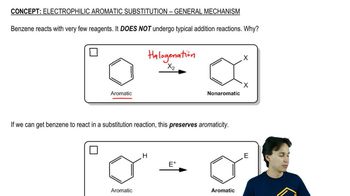
Electrophilic Aromatic Substitution

Electrophilic aromatic substitution (EAS) is a fundamental reaction in organic chemistry where an electrophile replaces a hydrogen atom on an aromatic ring. In this reaction, the aromatic compound, such as toluene, acts as a nucleophile, attacking the electrophile. The presence of a Lewis acid like BF3 enhances the electrophilicity of the reactants, facilitating the substitution process.
Recommended video:

Lewis Acids and Bases

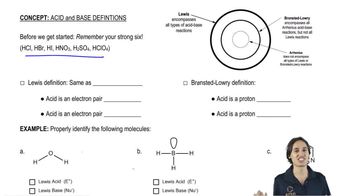
Lewis acids are substances that can accept an electron pair, while Lewis bases donate an electron pair. In this reaction, BF3 acts as a Lewis acid, coordinating with the alcohol (butan-1-ol) to form a more reactive species. This interaction is crucial for the activation of the alcohol, allowing it to participate in the electrophilic substitution with toluene.
Recommended video:
Guided course
02:49
The Lewis definition of acids and bases.

Reactivity of Alcohols

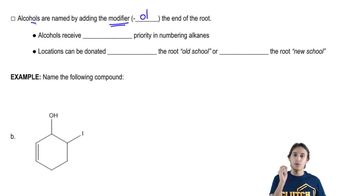
Alcohols can act as nucleophiles in organic reactions, but their reactivity often requires activation, especially in the presence of Lewis acids. In this case, butan-1-ol can be protonated or activated by BF3, making it a better nucleophile. Understanding how alcohols interact with Lewis acids is essential for predicting the products of the reaction involving toluene and butan-1-ol.
Recommended video:
Guided course
01:01
How to name alcohols