
Ch. 17 - Reactions of Aromatic Compounds
Wade - Organic Chemistry 9th Edition
Wade9th EditionOrganic ChemistryISBN: 9780135213728Not the one you use?Change textbook
Chapter 17, Problem 15c

Propose products (if any) and mechanisms for the following AlCl3-catalyzed reactions:
c. 3-chloro-2,2-dimethylbutane with isopropylbenzene

Verified step by step guidance
1
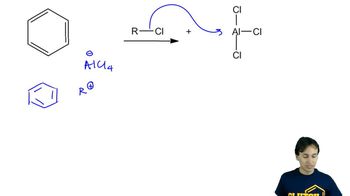
Step 1: Recognize that this reaction involves Friedel-Crafts alkylation, which is catalyzed by AlCl3. Friedel-Crafts alkylation typically involves the generation of a carbocation intermediate from an alkyl halide in the presence of AlCl3.
Step 2: Analyze the structure of 3-chloro-2,2-dimethylbutane. The chlorine atom is attached to a carbon that can form a carbocation. In the presence of AlCl3, the chlorine atom is abstracted, generating a carbocation. Due to the stability of carbocations, a rearrangement may occur to form a more stable tertiary carbocation.
Step 3: Consider the structure of isopropylbenzene (cumene). The benzene ring is electron-rich and can act as a nucleophile, attacking the carbocation formed in Step 2. The attack will result in the formation of a new C-C bond between the benzene ring and the carbocation.
Step 4: Predict the regioselectivity of the reaction. The isopropyl group on the benzene ring is an electron-donating group, which activates the ortho and para positions of the ring. The new substituent will likely attach at one of these positions.
Step 5: Conclude the mechanism by considering the final product. After the carbocation reacts with the benzene ring, the AlCl3 catalyst is regenerated, and the final product is formed. The product will be an alkylated aromatic compound with the new substituent at the ortho or para position relative to the isopropyl group.

Verified video answer for a similar problem:

This video solution was recommended by our tutors as helpful for the problem above.
Video duration:
10m
Was this helpful?

Key Concepts

Here are the essential concepts you must grasp in order to answer the question correctly.

Friedel-Crafts Alkylation

Friedel-Crafts alkylation is a reaction that introduces an alkyl group into an aromatic ring using an alkyl halide and a Lewis acid catalyst, such as AlCl3. In this process, the alkyl halide forms a carbocation, which then attacks the electron-rich aromatic ring, resulting in the substitution of a hydrogen atom with the alkyl group. This reaction is crucial for synthesizing more complex aromatic compounds.
Recommended video:
Guided course
06:30
Friedel-Crafts Alkylation

Carbocation Stability

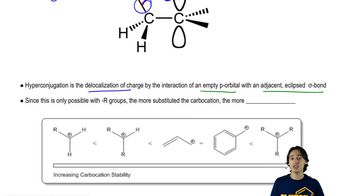
Carbocation stability is a key factor in determining the outcome of reactions involving carbocations. Tertiary carbocations are more stable than secondary or primary ones due to hyperconjugation and inductive effects from surrounding alkyl groups. In the context of the given reaction, the stability of the carbocation formed from 3-chloro-2,2-dimethylbutane will influence the likelihood of its formation and subsequent reaction with isopropylbenzene.
Recommended video:
Guided course
05:58
Determining Carbocation Stability

Regioselectivity in Electrophilic Aromatic Substitution

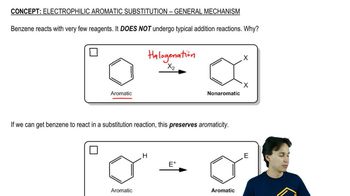
Regioselectivity refers to the preference of a chemical reaction to yield one structural isomer over others when multiple possibilities exist. In electrophilic aromatic substitution reactions, the position where the electrophile attacks the aromatic ring can be influenced by the substituents already present on the ring. In this case, the isopropyl group on isopropylbenzene is an electron-donating group, which directs the incoming carbocation to the ortho or para positions, affecting the final product distribution.
Recommended video: