Ch. 17 - Reactions of Aromatic Compounds
Wade - Organic Chemistry 9th Edition
Wade9th EditionOrganic ChemistryISBN: 9780135213728Not the one you use?Change textbook
Chapter 17, Problem 1

Step 2 of the iodination of benzene shows water acting as a base and removing a proton from the sigma complex. We did not consider the possibility of water acting as a nucleophile and attacking the carbocation, as in an electrophilic addition to an alkene. Draw the reaction that would occur if water reacted as a nucleophile and added to the carbocation. Explain why this type of addition is rarely observed.

Verified step by step guidance
1
Step 1: Begin by understanding the sigma complex formed during the iodination of benzene. The sigma complex is an intermediate where the benzene ring has temporarily lost aromaticity due to the attachment of the iodine atom, creating a carbocation on the ring.
Step 2: Consider the role of water as a nucleophile. Water has lone pairs of electrons on the oxygen atom, which can attack the carbocation in the sigma complex. This would result in the addition of a hydroxyl group (-OH) to the benzene ring, disrupting the aromaticity further.
Step 3: Draw the reaction mechanism. Represent the sigma complex with the carbocation and show water attacking the carbocation. Use curved arrows to indicate the movement of electrons from the oxygen atom of water to the carbocation. The product would be a benzene ring with an iodine atom and a hydroxyl group attached, but the ring would no longer be aromatic.
Step 4: Explain why this type of addition is rarely observed. Benzene and its derivatives strongly favor maintaining aromaticity due to the stability provided by the delocalized π-electrons. The addition of water as a nucleophile would result in the loss of aromaticity, making the product less stable than the original aromatic compound.
Step 5: Highlight the preference for water acting as a base rather than a nucleophile in this reaction. Water acting as a base removes a proton from the sigma complex, allowing the benzene ring to regain aromaticity, which is energetically favorable. This explains why the nucleophilic addition of water to the carbocation is not commonly observed in electrophilic aromatic substitution reactions.

Verified video answer for a similar problem:

This video solution was recommended by our tutors as helpful for the problem above.
Video duration:
9m
Was this helpful?

Key Concepts

Here are the essential concepts you must grasp in order to answer the question correctly.

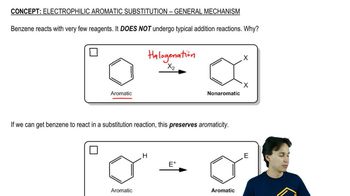
Electrophilic Aromatic Substitution (EAS)

Electrophilic Aromatic Substitution is a fundamental reaction mechanism in organic chemistry where an electrophile replaces a hydrogen atom on an aromatic ring. In the case of benzene iodination, the process involves the formation of a sigma complex (arenium ion) after the electrophile attacks the aromatic system. Understanding EAS is crucial for analyzing how different reagents interact with aromatic compounds and the stability of intermediates formed during the reaction.
Recommended video:

Sigma Complex (Arenium Ion)

The sigma complex, or arenium ion, is a key intermediate in electrophilic aromatic substitution reactions. It is formed when an electrophile adds to the aromatic ring, temporarily disrupting the aromaticity and creating a positively charged species. The stability of this intermediate is influenced by the substituents on the ring and the ability of the system to regain aromaticity, which is a driving force for the reaction to proceed.
Recommended video:
Guided course
05:02
Coordination Complexes

Nucleophilic Attack on Carbocations

Nucleophilic attack on carbocations involves a nucleophile donating a pair of electrons to a positively charged carbon atom, leading to the formation of a new bond. While water can act as a nucleophile, its addition to a carbocation in the context of electrophilic aromatic substitution is rare due to the high stability of the sigma complex and the preference for the aromatic system to restore its aromaticity. This preference makes the nucleophilic pathway less favorable compared to the established EAS mechanism.
Recommended video:
Guided course
07:21
Any Carbocation