Ch. 17 - Reactions of Aromatic Compounds
Wade - Organic Chemistry 9th Edition
Wade9th EditionOrganic ChemistryISBN: 9780135213728Not the one you use?Change textbook
Chapter 17, Problem 2

Propose a mechanism for the aluminum chloride–catalyzed reaction of benzene with chlorine.

Verified step by step guidance
1
The reaction is an example of an electrophilic aromatic substitution (EAS) reaction. Begin by recognizing that aluminum chloride (AlCl₃) acts as a Lewis acid catalyst, which helps to generate the electrophile (Cl⁺) from molecular chlorine (Cl₂).
In the first step, AlCl₃ interacts with Cl₂ to form a complex: \( \text{Cl}_2 + \text{AlCl}_3 \rightarrow \text{Cl}^+ + \text{AlCl}_4^- \). This generates the highly reactive electrophile, \( \text{Cl}^+ \).
Next, the benzene ring, which is electron-rich due to its delocalized π-electrons, attacks the \( \text{Cl}^+ \) electrophile. This forms a sigma complex (also called an arenium ion), where one of the benzene carbons is bonded to the chlorine atom, and the aromaticity of the ring is temporarily lost.
In the subsequent step, the sigma complex loses a proton (H⁺) from the carbon bonded to the chlorine atom. This proton is abstracted by \( \text{AlCl}_4^- \), regenerating \( \text{AlCl}_3 \) and forming HCl as a byproduct. The aromaticity of the benzene ring is restored in this step.
Finally, the overall reaction results in the formation of chlorobenzene (C₆H₅Cl) and HCl, with \( \text{AlCl}_3 \) acting as a catalyst and being regenerated at the end of the reaction.

Verified video answer for a similar problem:

This video solution was recommended by our tutors as helpful for the problem above.
Video duration:
11m
Was this helpful?

Key Concepts

Here are the essential concepts you must grasp in order to answer the question correctly.

Electrophilic Aromatic Substitution

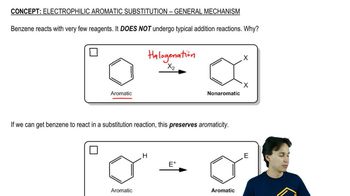
Electrophilic aromatic substitution (EAS) is a fundamental reaction in organic chemistry where an electrophile replaces a hydrogen atom on an aromatic ring. In this mechanism, the aromatic system donates electrons to the electrophile, forming a sigma complex. This process is crucial for understanding how benzene reacts with various electrophiles, including chlorine in the presence of a catalyst like aluminum chloride.
Recommended video:

Role of Aluminum Chloride as a Catalyst

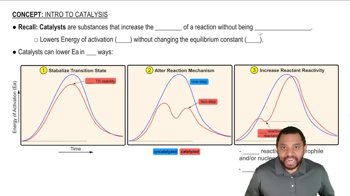
Aluminum chloride (AlCl3) acts as a Lewis acid catalyst in the reaction between benzene and chlorine. It enhances the electrophilicity of chlorine by forming a complex with it, which generates a more reactive electrophile, Cl+. This activation is essential for facilitating the EAS mechanism, allowing the chlorine to effectively attack the benzene ring.
Recommended video:
2:10
Introduction to Catalysis Concept 1

Formation of the Sigma Complex

The sigma complex, or arenium ion, is an intermediate formed during the electrophilic aromatic substitution process. When the electrophile attacks the benzene ring, it disrupts the aromaticity, leading to a positively charged intermediate. This step is critical as it determines the stability of the reaction pathway and influences the final product formation after deprotonation.
Recommended video:
Guided course
05:02
Coordination Complexes