Ch. 17 - Reactions of Aromatic Compounds
Wade - Organic Chemistry 9th Edition
Wade9th EditionOrganic ChemistryISBN: 9780135213728Not the one you use?Change textbook
Chapter 17, Problem 6

Styrene (vinylbenzene) undergoes electrophilic aromatic substitution much faster than benzene, and the products are found to be primarily ortho- and para-substituted styrenes. Use resonance forms of the intermediates to explain these results.

Verified step by step guidance
1
Identify the structure of styrene (vinylbenzene). Styrene consists of a benzene ring with an attached vinyl group (-CH=CH2). The vinyl group is an electron-donating group due to resonance effects, which increases the electron density in the benzene ring.
Explain the effect of the vinyl group on the reactivity of the benzene ring. The electron-donating resonance effect of the vinyl group stabilizes the benzene ring, making it more reactive toward electrophilic aromatic substitution compared to benzene itself.
Draw the resonance structures of the intermediate carbocation formed during electrophilic aromatic substitution. Focus on the ortho and para positions relative to the vinyl group. Show how the positive charge can be delocalized into the vinyl group, providing additional stabilization.
Compare the stability of the intermediates for ortho, meta, and para substitution. The ortho and para intermediates are more stabilized due to resonance interactions with the vinyl group, while the meta intermediate does not benefit from this stabilization.
Conclude that the increased reactivity of styrene and the preference for ortho- and para-substitution are due to the resonance stabilization provided by the vinyl group. This explains why electrophilic aromatic substitution occurs faster and predominantly at these positions.

Verified video answer for a similar problem:

This video solution was recommended by our tutors as helpful for the problem above.
Was this helpful?

Key Concepts

Here are the essential concepts you must grasp in order to answer the question correctly.

Electrophilic Aromatic Substitution (EAS)

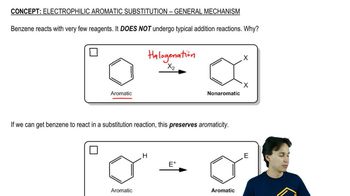
Electrophilic Aromatic Substitution is a fundamental reaction in organic chemistry where an electrophile replaces a hydrogen atom on an aromatic ring. This process involves the formation of a sigma complex (arenium ion), which is stabilized by resonance. The reactivity and orientation of the substitution depend on the substituents already present on the aromatic ring, influencing the stability of the intermediates formed during the reaction.
Recommended video:

Resonance Stabilization

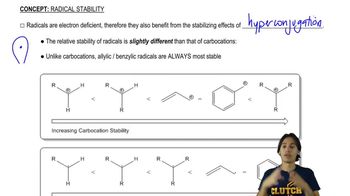
Resonance stabilization refers to the delocalization of electrons across multiple structures, which enhances the stability of a molecule. In the case of styrene, the positive charge in the sigma complex can be distributed over the aromatic ring through resonance, particularly favoring the ortho and para positions due to the electron-donating effect of the vinyl group. This stabilization makes the formation of these products more favorable compared to meta substitution.
Recommended video:
Guided course
03:43
The radical stability trend.

Ortho- and Para-Directing Effects

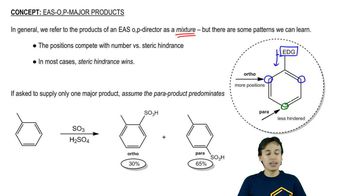
Ortho- and para-directing effects are observed in electrophilic aromatic substitution reactions where certain substituents influence the position of new substituents on the aromatic ring. Electron-donating groups, like the vinyl group in styrene, increase electron density at the ortho and para positions, making these sites more reactive towards electrophiles. This results in a higher proportion of ortho- and para-substituted products compared to meta-substituted products.
Recommended video:
Guided course
04:42
Ortho, Para major products