Ch. 18 - Ketones and Aldehydes
Wade - Organic Chemistry 9th Edition
Wade9th EditionOrganic ChemistryISBN: 9780135213728Not the one you use?Change textbook
Chapter 18, Problem 54b

Predict the products formed when cyclohexanecarbaldehyde reacts with the following reagents.
b. Tollens reagent

Verified step by step guidance
1
Step 1: Recognize the functional group in cyclohexanecarbaldehyde. Cyclohexanecarbaldehyde contains an aldehyde functional group (-CHO) attached to a cyclohexane ring.
Step 2: Understand the nature of Tollens reagent. Tollens reagent is a mild oxidizing agent, typically consisting of ammoniacal silver nitrate ([Ag(NH3)2]+). It selectively oxidizes aldehydes to carboxylic acids while leaving other functional groups unaffected.
Step 3: Predict the reaction mechanism. The aldehyde group in cyclohexanecarbaldehyde will be oxidized by Tollens reagent. The silver ion in Tollens reagent is reduced to metallic silver (Ag), which often forms a shiny silver mirror on the reaction vessel.
Step 4: Write the chemical transformation. The aldehyde group (-CHO) is converted into a carboxylic acid group (-COOH). The product formed will be cyclohexanecarboxylic acid.
Step 5: Summarize the reaction. The reaction involves the oxidation of cyclohexanecarbaldehyde to cyclohexanecarboxylic acid, with the reduction of silver ions to metallic silver as a side product.

Verified video answer for a similar problem:

This video solution was recommended by our tutors as helpful for the problem above.
Video duration:
2m
Was this helpful?

Key Concepts

Here are the essential concepts you must grasp in order to answer the question correctly.

Tollens' Reagent

Tollens' reagent is a solution of silver nitrate in ammonia, commonly used to test for aldehydes. It contains the complex ion [Ag(NH3)2]+, which oxidizes aldehydes to carboxylic acids while reducing silver ions to metallic silver. This reaction is characterized by the formation of a silver mirror on the reaction vessel, indicating the presence of an aldehyde.
Recommended video:

Aldehyde Reactivity

Aldehydes are highly reactive compounds due to the presence of a carbonyl group (C=O) at the end of their carbon chain. This reactivity allows them to undergo various chemical reactions, including oxidation and nucleophilic addition. In the case of Tollens' reagent, the aldehyde is oxidized to a carboxylic acid, demonstrating its susceptibility to oxidation.
Recommended video:
Guided course
01:34
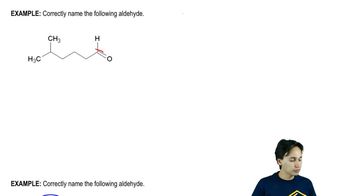
Name the aldehyde

Cyclohexanecarbaldehyde Structure

Cyclohexanecarbaldehyde is a cyclic aldehyde with a six-membered carbon ring and an aldehyde functional group attached to one of the carbons. Its structure influences its reactivity, as the steric and electronic environment around the carbonyl group can affect how it interacts with reagents like Tollens' reagent. Understanding its structure is crucial for predicting the products of its reactions.
Recommended video:
Guided course
03:04
Drawing Resonance Structures