
Ch. 18 - Ketones and Aldehydes
Wade - Organic Chemistry 9th Edition
Wade9th EditionOrganic ChemistryISBN: 9780135213728Not the one you use?Change textbook
Chapter 18, Problem 33a,b

Show how Wittig reactions might be used to synthesize the following compounds. In each case, start with an alkyl halide and a ketone or an aldehyde.
(a) Ph–CH=C(CH3)2
(b) Ph–C(CH3)=CH2

Verified step by step guidance
1
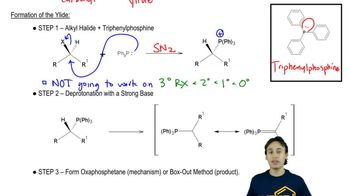
Step 1: Understand the Wittig reaction. The Wittig reaction is used to form alkenes by reacting a phosphonium ylide with a carbonyl compound (ketone or aldehyde). The ylide is typically prepared from an alkyl halide and triphenylphosphine.
Step 2: For compound (i), identify the alkene structure. The target compound has a phenyl group attached to a double bond, with ethyl groups on both sides of the double bond. This suggests the Wittig reaction involves a ketone with a phenyl group and a ylide derived from an ethyl halide.
Step 3: Synthesize the ylide for (i). React ethyl bromide (CH3CH2Br) with triphenylphosphine (PPh3) to form the phosphonium salt. Then treat the salt with a strong base (e.g., NaH or BuLi) to generate the ylide.
Step 4: Select the carbonyl compound for (i). Use acetophenone (C6H5COCH3) as the ketone. React the ylide with acetophenone to form the desired alkene product.
Step 5: For compound (ii), analyze the structure. The target compound has a phenyl group attached to a double bond, with an ethyl group and a hydrogen on the double bond. This suggests the Wittig reaction involves benzaldehyde (C6H5CHO) and a ylide derived from ethyl bromide. Follow the same ylide preparation steps as in (i), then react the ylide with benzaldehyde to form the desired alkene.

Verified video answer for a similar problem:

This video solution was recommended by our tutors as helpful for the problem above.
Video duration:
10m
Was this helpful?

Key Concepts

Here are the essential concepts you must grasp in order to answer the question correctly.

Wittig Reaction

The Wittig reaction is a chemical reaction that allows for the formation of alkenes through the reaction of an aldehyde or ketone with a phosphonium ylide. This reaction is significant in organic synthesis as it provides a method to create double bonds with high stereoselectivity, enabling the construction of complex molecules from simpler precursors.
Recommended video:
Guided course
15:39
Box-Out Method and Full-Mechanism

Phosphonium Ylide

A phosphonium ylide is a compound containing a positively charged phosphorus atom bonded to a negatively charged carbon atom. This species is crucial in the Wittig reaction, as it acts as a nucleophile that attacks the carbonyl carbon of the aldehyde or ketone, leading to the formation of the alkene product after elimination of the phosphine oxide.
Recommended video:
Guided course
15:39
Box-Out Method and Full-Mechanism

Alkyl Halides

Alkyl halides are organic compounds containing a carbon atom bonded to a halogen atom (such as chlorine, bromine, or iodine). In the context of the Wittig reaction, alkyl halides serve as starting materials that can be converted into phosphonium ylides, which are then used to react with carbonyl compounds to synthesize alkenes.
Recommended video:
Guided course
01:52
How to name alkyl halides