Ch. 18 - Ketones and Aldehydes
Wade - Organic Chemistry 9th Edition
Wade9th EditionOrganic ChemistryISBN: 9780135213728Not the one you use?Change textbook
Chapter 18, Problem 31b

Like other strong nucleophiles, triphenylphosphine attacks and opens epoxides. The initial product (a betaine) quickly cyclizes to an oxaphosphetane that collapses to an alkene and triphenylphosphine oxide.
(b) Show how this sequence might be used to convert cis-cyclooctene to trans-cyclooctene.

Verified step by step guidance
1
Step 1: Understand the reaction mechanism. Triphenylphosphine (PPh₃) acts as a strong nucleophile and attacks the epoxide ring, leading to the formation of a betaine intermediate. This intermediate then cyclizes to form an oxaphosphetane.
Step 2: Recognize the stereochemical implications. The epoxide opening by triphenylphosphine occurs with inversion of configuration at the carbon atom being attacked. This inversion is key to converting cis-cyclooctene to trans-cyclooctene.
Step 3: Apply the reaction sequence. First, react cis-cyclooctene with a peracid (e.g., mCPBA) to form the corresponding epoxide. Ensure the stereochemistry of the epoxide matches the cis configuration of the starting alkene.
Step 4: Introduce triphenylphosphine to the epoxide. The nucleophilic attack by PPh₃ opens the epoxide ring, forming the betaine intermediate, which cyclizes to the oxaphosphetane. This intermediate collapses to yield the trans-cyclooctene and triphenylphosphine oxide.
Step 5: Confirm the stereochemical outcome. The reaction sequence results in the inversion of configuration, converting the cis-cyclooctene to trans-cyclooctene. Verify the stereochemistry of the product using spectroscopic methods or other analytical techniques.

Verified video answer for a similar problem:

This video solution was recommended by our tutors as helpful for the problem above.
Video duration:
7m
Was this helpful?

Key Concepts

Here are the essential concepts you must grasp in order to answer the question correctly.

Nucleophilicity

Nucleophilicity refers to the ability of a nucleophile to donate an electron pair to an electrophile, forming a chemical bond. Strong nucleophiles, like triphenylphosphine, are highly reactive and can effectively attack electrophilic centers, such as the carbon atoms in epoxides. Understanding nucleophilicity is crucial for predicting reaction pathways and mechanisms in organic chemistry.
Recommended video:
Guided course
08:27
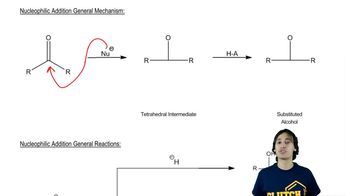
Nucleophilic Addition

Epoxide Ring Opening

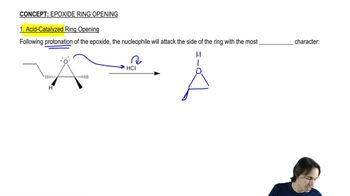
Epoxide ring opening is a reaction where a nucleophile attacks one of the carbon atoms in an epoxide, leading to the cleavage of the three-membered ring. This reaction typically results in the formation of a more stable product, such as a betaine intermediate. The regioselectivity and stereochemistry of the attack are influenced by the nature of the nucleophile and the substituents on the epoxide.
Recommended video:
Guided course
04:34
Acid-Catalyzed Epoxide Ring-Opening

Cyclization and Rearrangement

Cyclization and rearrangement involve the transformation of intermediates into cyclic structures or the reorganization of atoms within a molecule. In this context, the betaine formed from the epoxide opening can cyclize to form an oxaphosphetane, which is a cyclic compound containing phosphorus. This intermediate can then collapse to yield an alkene and triphenylphosphine oxide, illustrating the dynamic nature of organic reactions.
Recommended video:
Guided course
12:58
Monosaccharides - Cyclization